

Tips for Play
Owner's guide
It Moves, It Wrestles, and It Might Spook Your Cat at First
A wearable puppet whose jaw and paws move with your hand. That is what makes it thrilling once your cat trusts it, and why some cats need a week to get there. If yours ran off, hid, or gave it one sniff and went back to sleep, you are in the right place.

Start here
Which cat is on your floor?
Tap the one that sounds like yours. We will point you at the right step to start on.
Pick one above
Almost every cat gets to the same place. They just take different roads, and the road matters more than the pace.
Spooked
Go slower than feels necessary.
They are not rejecting the toy, they are rejecting the surprise. Nothing speeds this up except taking the pressure off. The cats that take longest often end up the keenest wrestlers.
Watching
You are close. Stop advancing.
Watching from a distance is the last stop before contact. Let them close the gap themselves so it stays their decision.
Unimpressed
It does not read as alive yet.
They have filed it as furniture. Cats chase things that stutter, hide and flee, not things that glide smoothly across the carpet.
All in
Skip ahead and set some limits.
You have a contact play cat with a backlog of drive. The job now is keeping sessions short enough that play stays play.
The introduction ladder
Five steps, in order
Tap a step to open it. Only move up when your cat is relaxed at the step they are on.
Leave it on the floor and walk away
Your cat has to decide the puppet is safe before they can decide it is fun. That decision happens faster when nobody is watching and nothing is moving.
- Put it where your cat already hangs out.
- Leave it a few hours, or overnight.
Do not wear it, wave it, or watch them approach it.
It has to become furniture before it can become a toy.
Move on when: they have sniffed it and stopped caring.
Make it move without wearing it
Now give the puppet some life, but keep yourself out of it. Movement at a distance is interesting. Movement attached to a person is a much bigger claim to accept.
- Dangle it. Spin it slowly.
- Drag it across the floor away from your cat, never toward them.
- Crinkle the ears so it makes a sound as it moves.
Do not put your hand inside it yet.
Prey that flees is interesting. Prey that advances is a threat.
Move on when: ears go forward, eyes track it, or a paw comes out.
Put it on and be boring
This is the step everyone wants to skip, and the one that does most of the work. Your cat needs to see the puppet on your arm doing nothing at all before they will accept it doing something.
- Sit on the floor. Floor level takes a foot of intimidation off you.
- Slide it on and rest it on your knee.
- Read your phone. Watch television. Ignore your cat completely.
Do not lunge if they come close. Let them sniff and wander off.
It breaks the link between the puppet moving and something happening to them.
Move on when: they investigate it on your arm and stay calm.
Twitch, do not charge
First contact is a nerve game, and small beats big every time. A hunting brain is tuned to partial information, so a target that half hides is far more compelling than one out in the open.
- Tiny movements only. A paw flick. A slow crawl along the sofa edge.
- Let it peek over a cushion, then duck back out of sight.
- The moment they touch it, retreat as though the puppet lost.
Do not chase your cat with it. Ever.
Half hidden beats fully visible, and winning is the reward.
Move on when: they grab it and hold on.
Full sumo
Once your cat grabs and holds, you can wrestle properly. This is the play they have been asking you for, and the padded head and long sleeve are what let you give it to them without paying for it in forearm.
- Push and pull like a yo-yo. In, out, in, out.
- Work along their side rather than head on. Head on reads as confrontation.
- Let them pin it and win roughly every thirty seconds.
Do not play past the point where the tail starts thrashing.
A toy that never loses stops being fun very quickly.
You are there. Now learn to read the four moves below.
Read your cat
The four moves
Cats wrestle with a small, fixed vocabulary. Spotting these four tells you what your cat wants next, and each one has a specific thing you can do to feed it.


Session length
The ten minute rule
Short and frequent beats long and occasional, for both of you.
- Dusk and dawn are free wins. That is when the hunting drive peaks, and when your ankles usually pay for it.
- Always finish on a catch. Ending on a miss leaves your cat wound up.
- Stop before they do. One minute early keeps the puppet exciting. Five minutes late teaches them it is boring.
- Put it away between sessions. A toy that is always out stops being an event.
Troubleshooting
Something is not working
Tap whichever one sounds like tonight.
They leave the room
Go back to step 1. Puppet on the floor, in their space, untouched, overnight. Nothing you do now speeds this up except removing pressure.
They watch but will not come closer
Move it away from them, never toward. Or slide it under a bedsheet so only the shape shows. The bedsheet trick converts more watchers than anything else we know.
One sniff, then nothing
It does not read as alive yet. Crinkle the ears for sound, then use short erratic twitches. Smooth motion reads as an object being held.
They quit after twenty seconds
Let them win one. Go limp on contact, then twitch back to life. Cats give up on targets that are impossible to catch much faster than on ones that fight and lose.
They loved it, now they are bored
Usually the catnip, not the toy. It loses its punch once a sachet has been opened, squashed and slept on. Swapping the sachets in the puppet's pockets is normally all it takes.
They go far too hard, straight away
Shorter sessions, more often. Ten minutes, two or three times a day, beats one long war. This is usually a backlog of drive with nowhere to go.
They redirect onto my other hand
Keep your free hand behind your back. One opponent on the mat at a time. Anything else in reach becomes a target.
Play tips into real aggression
Freeze. Puppet still, you quiet. Come back in a few hours rather than a few minutes. The tail and the ears warned you before the paws did.
They wrestle everywhere except where I want them to
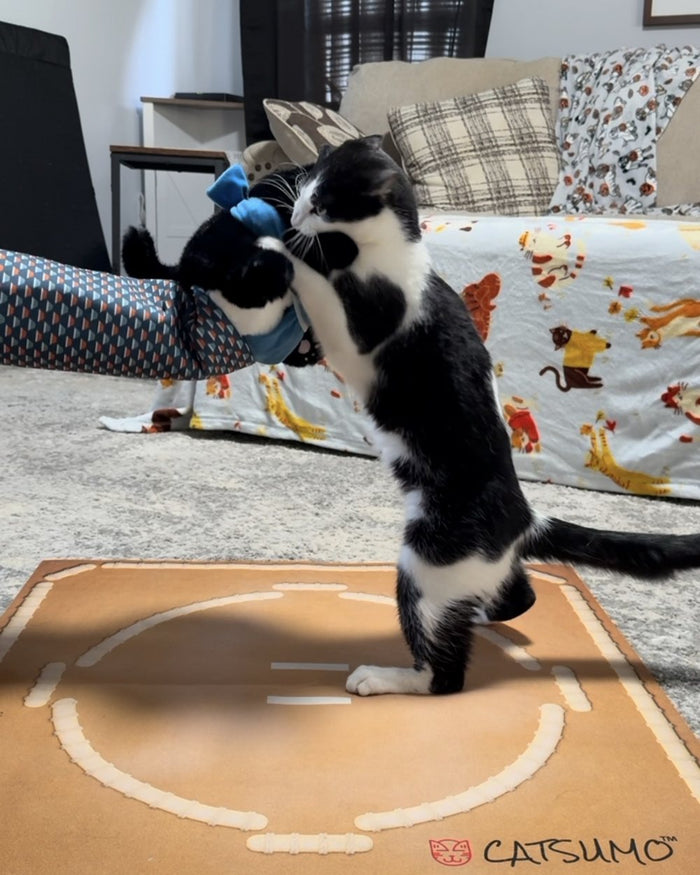
Give the session a fixed ring. Starting in the same spot every time teaches your cat where play happens, and gives their claws something that is not your rug.
A folded blanket in a fixed spot works. So does a proper mat.
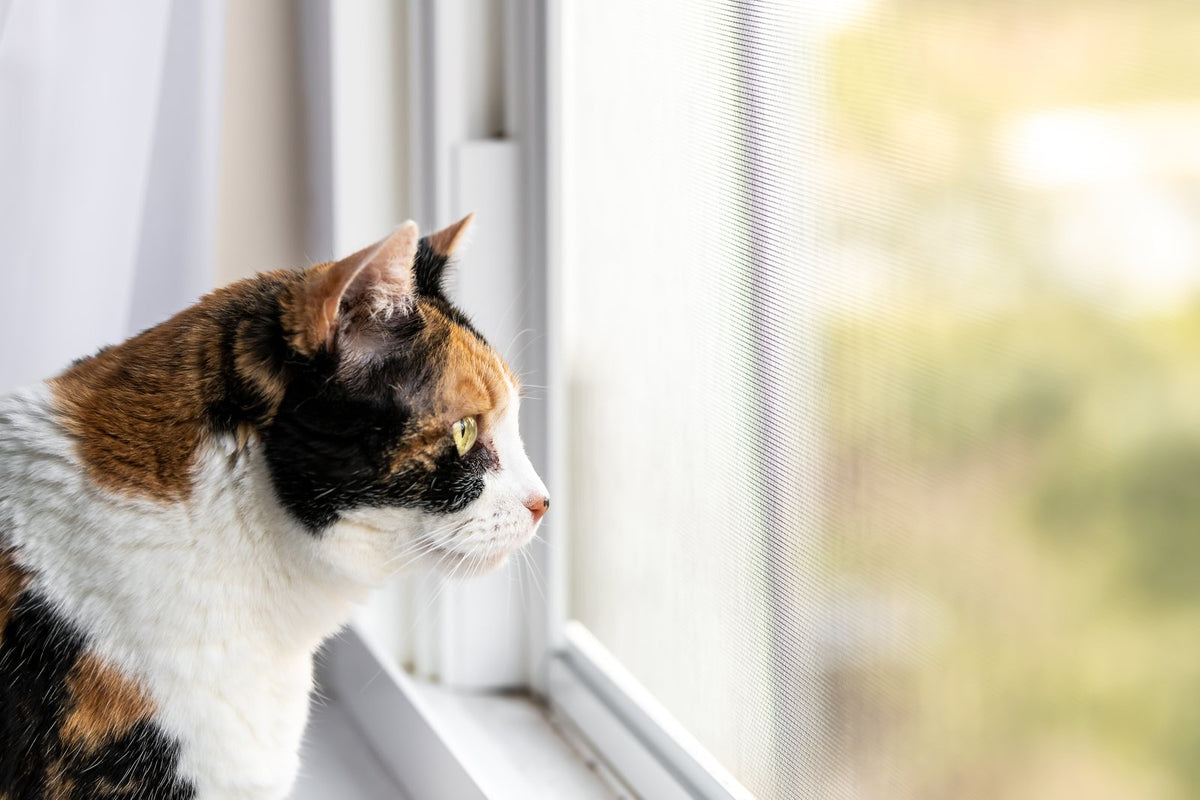
If engagement stalls
Two things that make play easier
Neither is required, and neither replaces technique. Both solve a specific problem owners write to us about.

For the cat that will not commit
Catnip Refill Pack
Catnip loses its punch once a sachet has been opened, squashed and slept on. A fresh one in the puppet's pockets restores the scent cue, which is often the nudge that gets a hesitant cat close enough to make the first grab.
- Strengthens the smell that draws them in
- Drops straight into the pockets already in the puppet
- Sealed sachets, so no loose catnip on the rug

For play that happens everywhere
Dohyo Wrestling Mat
A padded ring in a fixed spot tells your cat where play happens, which makes starting a session easier. It also cushions the rolls and bunny kicks, and gives claws something to sink into that is not the sofa.
- A start line your cat learns to recognise
- Keeps claws off rugs, sofas and chair legs
- Softer landing for side and back play
In the wild
Cats who got there
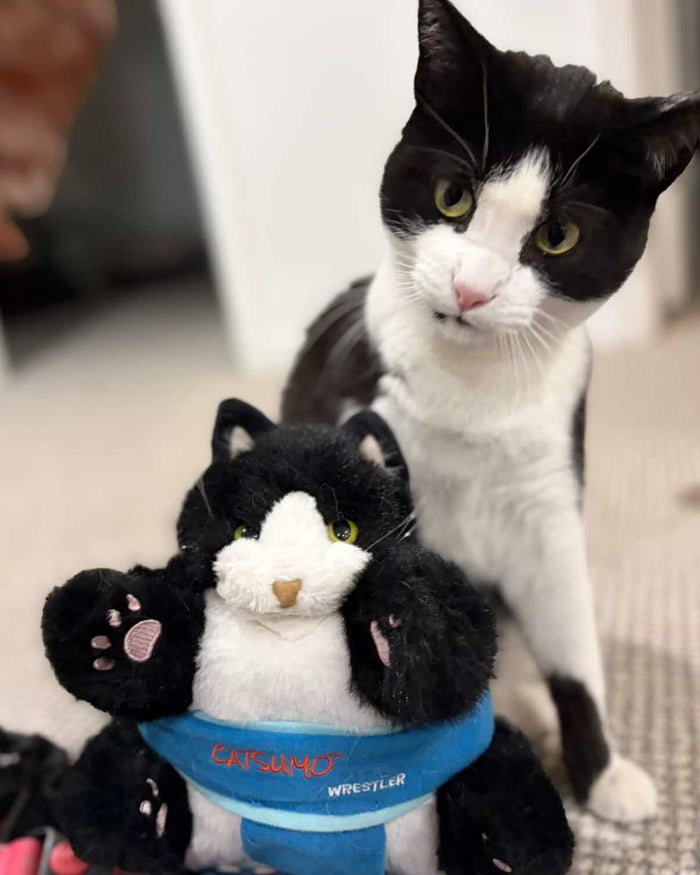
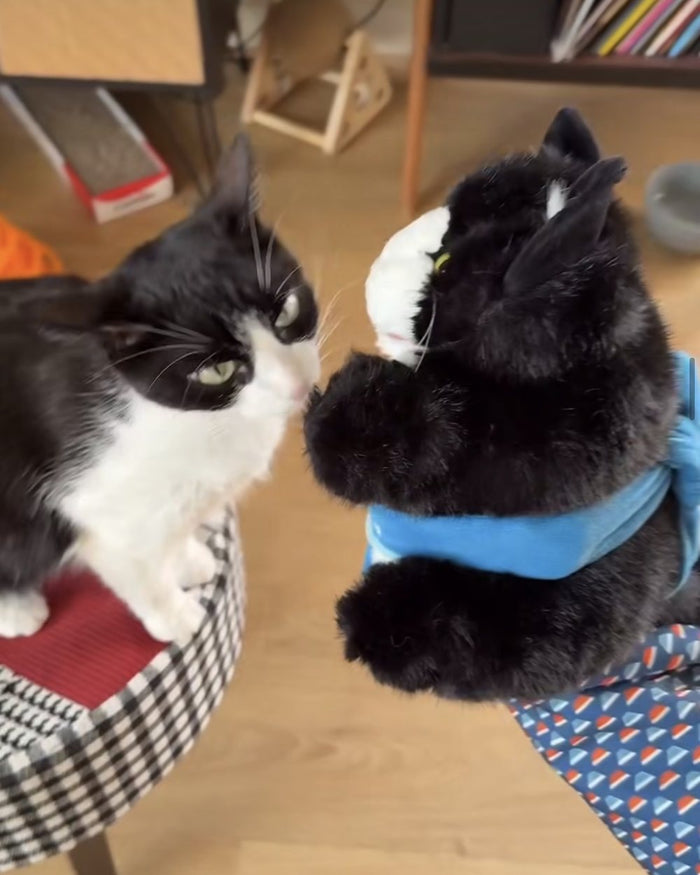
Every one of these started with a cat backing away from something new on the floor.
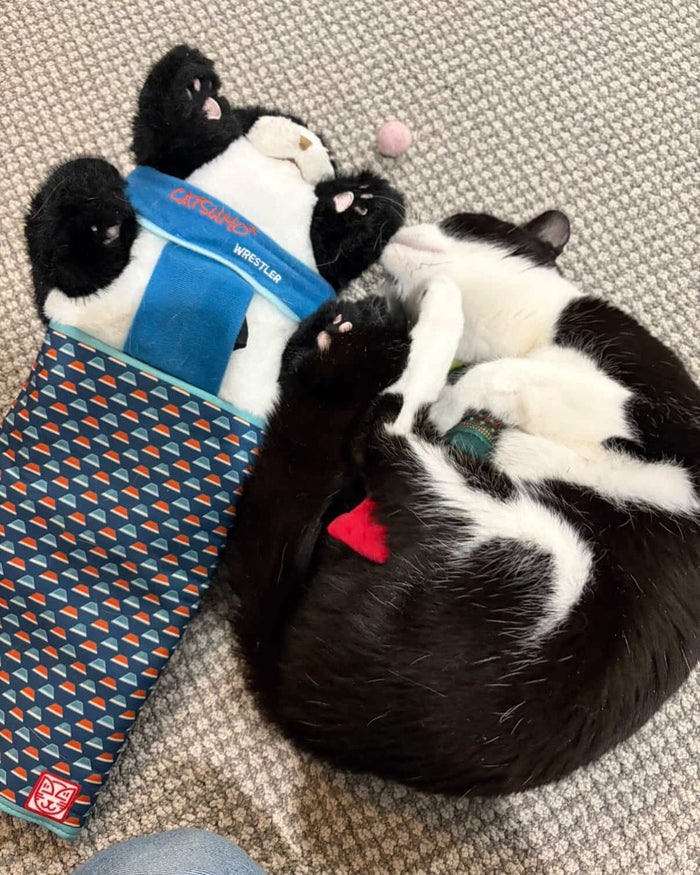
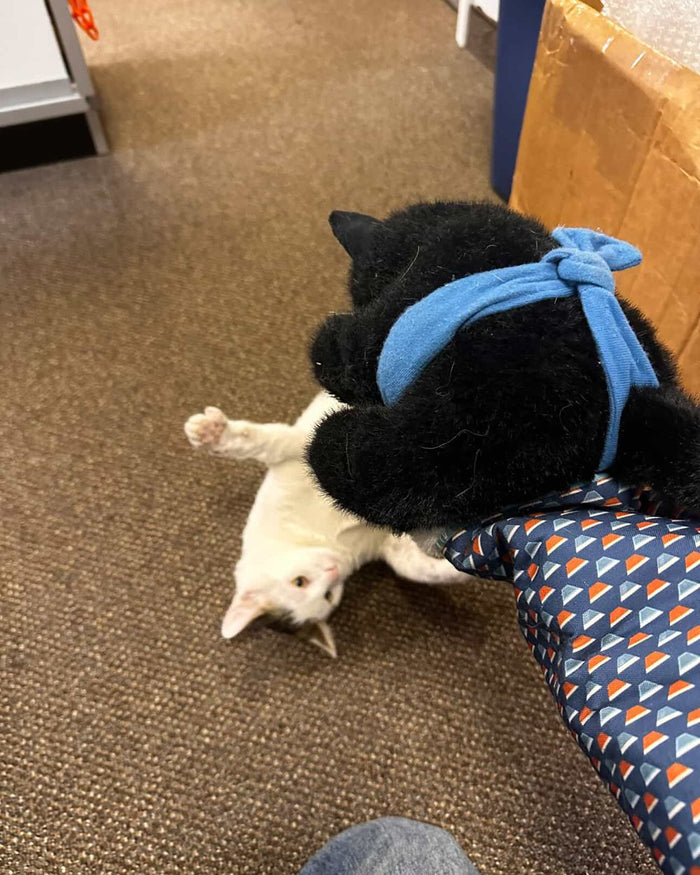
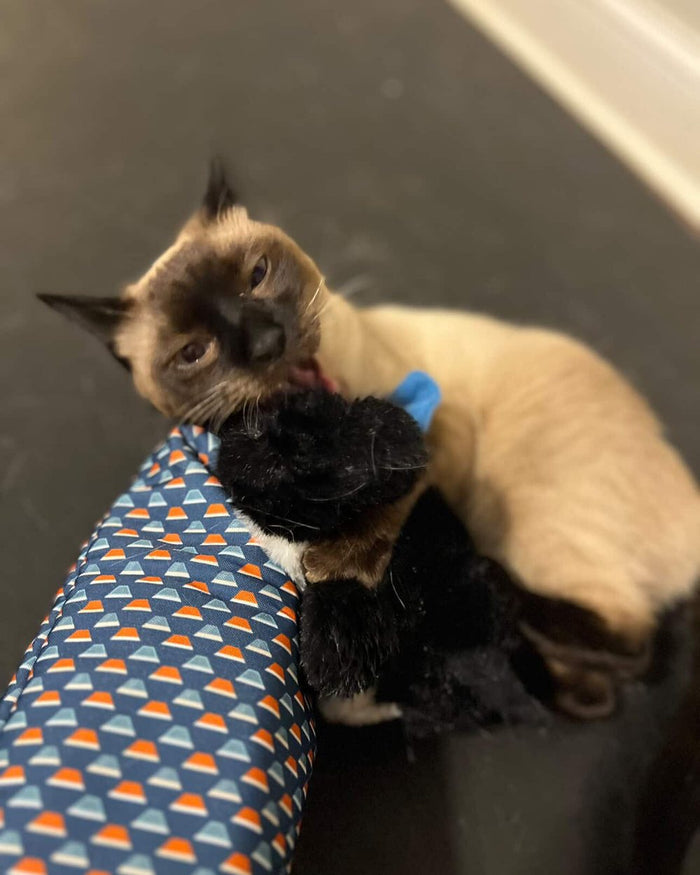
Care and safety
Keeping it in one piece
- Check the sleeve, seams and head for punctures after heavy sessions. Replace it once the padding is compromised.
- It gives you substantial protection, but it is not impenetrable. It is built for a cat with normal bite inhibition.
- If your cat plays extremely hard, start with sleeve only access and keep your fingers out of the head.
- If aggression is sudden, escalating, or aimed at people unprovoked, that is not a play problem. Talk to your vet.
Still worried that rough play teaches your cat to attack hands? We wrote about that here.
General guidance on cat play behaviour, not veterinary advice. Every cat is different. Trust your cat over the page.