

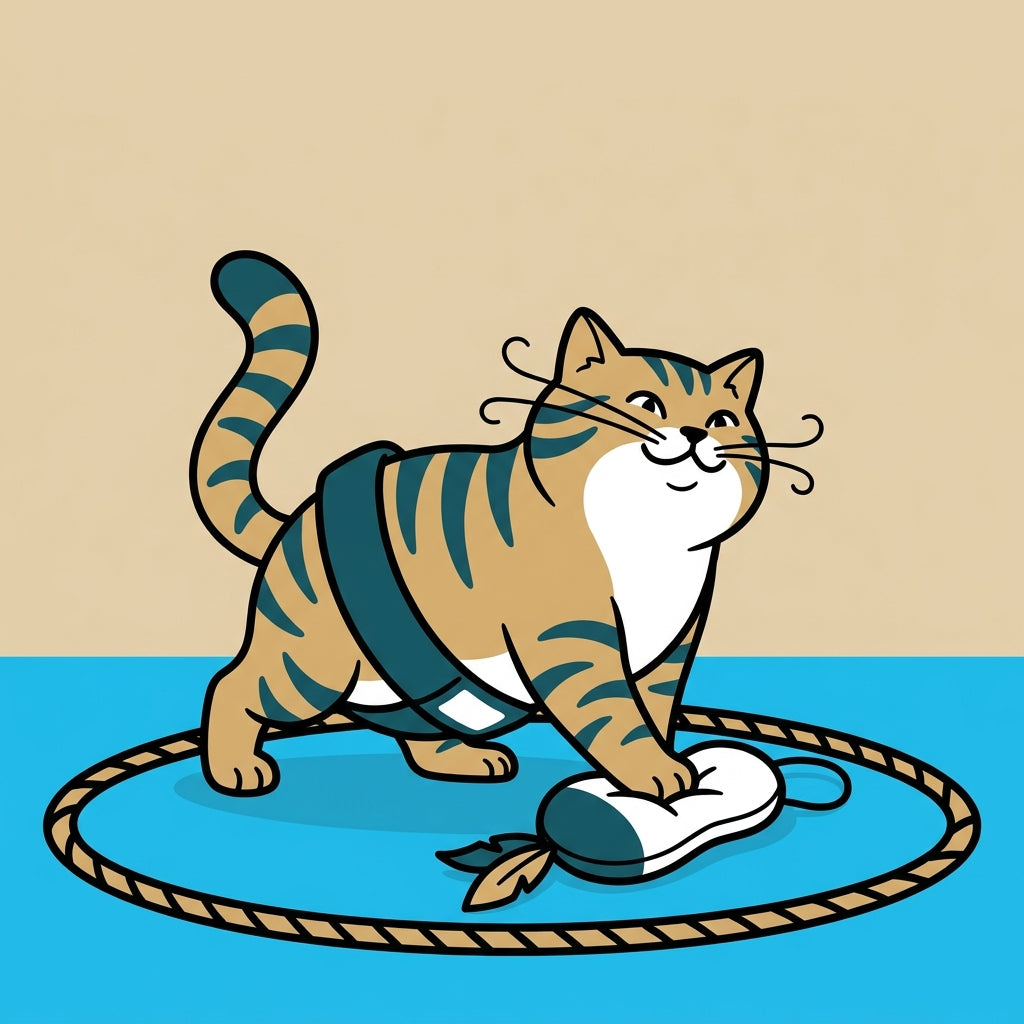
Short answer: laser pointers aren't dangerous, but they can be frustrating when they're the only game you play. A laser dot can't be caught, bitten, or "won," so a cat's built-in hunting sequence — stare, stalk, chase, pounce, bite — never gets to finish. Used occasionally, a laser is fine. Used as a cat's main toy, it can leave them wound up with nowhere to put that energy, which can look like post-play pacing, frantic meowing, or restlessness. The fix isn't to ban the laser — it's to always end the match on something your cat can actually catch.
On this page

The hunt has 5 rounds: stare, stalk, chase, catch, bite/"eat"
Every cat, from a barn cat to the fluffiest lap cat, carries the same built-in hunting program. Behaviorists call it the predatory sequence, and it runs in a fixed order: stare → stalk → chase → pounce/catch → bite → "eat" (or a vigorous grooming session that stands in for it). According to Preventive Vet's breakdown of the prey sequence, this pattern is hardwired, not optional — it's the same circuit whether your cat is after a real mouse, a feather wand, or a beam of light.
Think of it like a sumo match with five rounds:
- Stare — ears forward, body still, eyes locked onto the "prey."
- Stalk — a low, slow creep forward, weight shifting paw to paw.
- Chase — the sudden burst of speed once the target moves.
- Catch — the pounce and grab, claws out, prey pinned.
- Bite/"Eat" — a bite to the back of the neck (on a toy, often a hard chew or a satisfied grooming session afterward).
A full round of this sequence is deeply satisfying for a cat — it's a complete loop with a clear finish. The trouble starts when a game only ever delivers rounds 1 through 3 and quietly skips the last two.

The 5 rounds of a cat's hunt — stare, stalk, chase, catch, bite/"eat."
Why a laser pointer is a match that never ends
A laser pointer is brilliant at triggering rounds one through three. The dot darts, flickers, and vanishes unpredictably — exactly the kind of movement that flips a cat's stare-stalk-chase switches on. The problem is physics, not behavior: a beam of light has no mass, no scent, and nothing to grab. Round four, the catch, is structurally impossible. Round five never happens either.
This isn't just a hunch. A 2021 peer-reviewed study published in the journal Animals and hosted on PubMed Central — "Laser Light Pointers for Use in Companion Cat Play: Association with Guardian-Reported Abnormal Repetitive Behaviors" — surveyed cat guardians and found that cats who were played with using a laser pointer, especially without ever pairing it with a catchable toy, were more likely to show guardian-reported abnormal repetitive behaviors (things like fixating on light reflections or shadows outside of play). The researchers were careful not to claim laser play directly causes compulsive behavior in every cat, but the association was clear enough that they recommended always finishing a laser session on a toy the cat can physically catch.
In plain terms: the issue isn't the laser itself. It's a hunt that's allowed to end in "no decision" over and over again.
Signs your cat didn't get to "win"
- Pacing, restlessness, or an inability to settle right after a play session ends
- Meowing or yowling at walls, corners, or the spot where the light last was
- Repeatedly returning to stare at the same patch of floor or wall
- Over-grooming or chewing right after play, as if trying to finish something
- Seeming "keyed up" or irritable for longer than usual after playtime
An occasional version of these after one laser session is normal overflow energy. A consistent pattern, especially fixating on lights/shadows outside of play, is the specific signal the 2021 study flagged — and it's worth a chat with your vet or a certified cat behavior consultant if it keeps showing up.
How to give every play session a winner
You don't need to overhaul playtime — you need one consistent habit: always let the last round be a real catch. Here's a simple structure that works for a laser, a wand toy, or anything in between.
- Warm up with movement (2–5 minutes). Let the stare-stalk-chase rounds run their course. This is where a laser pointer, a flicked wand, or a dragged string all shine — fast, erratic, "alive"-feeling motion.
- Switch to something catchable before your cat tires out. A minute or two before you'd normally stop, swap the laser off (or set it aside) and bring in a toy with real texture — something with fabric, fur, feathers, or fronds your cat can actually close their paws and teeth around.
- Let the catch happen — and let it last. Don't yank the toy away the instant your cat grabs it. Let them bite it, kick it, carry it around. This is round four and five finishing in real time.
- Follow with a small "spoils of war" moment. A few pieces of kibble, a treat, or a fresh hit of catnip/silvervine right after the catch mirrors the natural "eat" step and signals the hunt is officially over.
- Keep total active play to about 10–15 minutes, once or twice a day, for most adult cats — short, intense, and complete beats long and open-ended.
This is exactly the gap a toy like the CATSUMO Sagari Teaser Belt is built to close. It's a wand-style accessory that slides onto the CATSUMO Wrestler, and its leather fronds and natural silvervine galls give a cat something genuinely chase-worthy and catchable — a real opponent with texture, resistance, and a scent, not just a flicker of light. After the laser's done its job warming things up, handing your cat something like this for the final round is what turns an open-ended chase into a finished match.

CATSUMO Sagari Teaser Belt
Slides onto the CATSUMO Wrestler to turn chase energy into a real, catchable finish — leather fronds and natural silvervine galls give your cat something to actually sink paws and teeth into. See the Sagari Teaser Belt →
Once the catch is won, a fresh scent can make that final moment even more rewarding. Keeping a pack of CATSUMO Catnip Refill Pack sachets on hand is an easy way to re-ignite interest in a toy whose catnip has gone stale — though it's worth remembering that not every cat responds strongly to catnip; some are simply indifferent to it, and that's completely normal.
Can you still use the laser?
Yes — a laser pointer is a perfectly fine warm-up tool as long as it isn't the whole game. Think of it as rounds one through three, not the entire match. A few practical rules of thumb:
- Never end a session on the laser. Always switch to a physical toy for the last minute or two so your cat gets an actual catch.
- Keep the beam moving like real prey — away from your cat, in erratic bursts, pausing in spots they can "corner" it — rather than straight at their eyes or face.
- Never point a laser directly into a cat's eyes. It's unnecessary for good play and can cause genuine discomfort or injury.
- Keep sessions short. A few minutes of laser warm-up is plenty before handing off to something catchable.
Used this way, the laser becomes part of a complete hunt instead of being the whole (unfinishable) hunt.
Laser pointer vs. wand/teaser toy

FAQ
Are laser pointers bad for cats?
Not inherently — but relying on one as a cat's only form of play can be a problem. A laser dot triggers the stare-stalk-chase part of a cat's hunting instinct but can never be physically caught, so the hunt never fully resolves. Pairing laser play with a catchable toy at the end avoids this issue entirely.
Why does my cat act frustrated or "crazy" after we play with the laser pointer?
This usually happens because the hunting sequence got cut short. Your cat built up chase energy with nowhere to land it, since there was never a physical "prey" to catch, bite, or carry off. Ending sessions on a real toy instead of the light resolves most of this.
What is the cat "prey sequence," and why does it matter for play?
The prey sequence is the fixed order of behaviors a cat's hunting instinct runs through: stare, stalk, chase, pounce/catch, and bite or "eat." It matters for play because a toy or game that only triggers the first few steps and never lets a cat finish the sequence can leave built-up energy with no outlet.
How do I end a cat play session the right way?
Finish on something your cat can physically catch and hold — a wand toy, a plush toy, or a stuffed toy — rather than a laser dot. Let them bite and carry the toy for a minute, then offer a small treat or fresh catnip/silvervine to mirror the natural "eat" step.
Can I still use a laser pointer safely?
Yes. Use it as a warm-up for the first few minutes of play, then switch to a physical toy for the finish so your cat gets a real catch every session. Avoid shining it directly into your cat's eyes.
What's the difference between a wand/teaser toy and a laser pointer?
Both can trigger a cat's chase instinct, but only a wand or teaser toy has real texture, resistance, and scent that a cat can actually catch and bite. A laser pointer is light with no mass, so the "catch" step is physically impossible.
Why does my cat need to physically "catch" something at the end of play?
Catching and biting are the final steps of the predatory sequence that bring a hunt to a satisfying close. Without them, some cats are left in a keyed-up, unresolved state that can show up as pacing, vocalizing, or trouble settling down.
How long should an interactive cat play session last?
Most adult cats do well with about 10–15 minutes of active, interactive play, once or twice a day — short and complete tends to work better than long and open-ended, especially when each session ends with a real catch.
Sources
- Preventive Vet — Cat Play Sessions Using the Prey Sequence
- Animals (MDPI), via PubMed Central — Laser Light Pointers for Use in Companion Cat Play: Association with Guardian-Reported Abnormal Repetitive Behaviors
- PetMD — Why Do Cats Bunny Kick? (catnip variation reference)
This article is for general educational purposes and is not a substitute for individualized veterinary or behavioral advice. If your cat shows sudden changes in behavior, compulsive fixation on lights or shadows outside of play, or other concerning patterns, please consult your veterinarian or a certified feline behavior consultant.

Leave a comment
This site is protected by hCaptcha and the hCaptcha Privacy Policy and Terms of Service apply.