

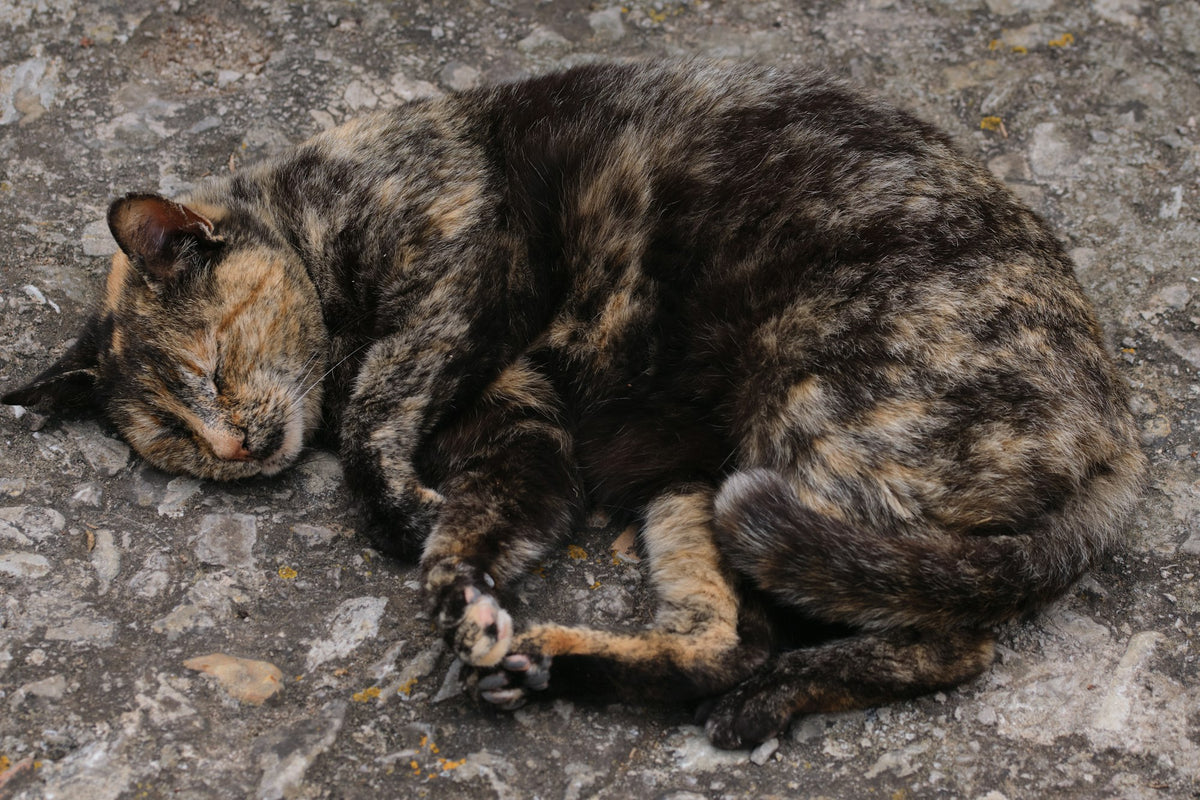
Cats aren't lazy for sleeping 12–18 hours a day — it's an inherited energy-conservation strategy. Wild hunting is a boom-or-bust job: short, explosive bursts of stalking and pouncing followed by long stretches of rest to recharge. Your couch-bound cat still runs on that same "short match, long recovery" clock, even though the mouse is now a toy.
On this page
How much do cats actually sleep?
Most cats sleep somewhere between 12 and 18 hours in a 24-hour day, and it's genuinely normal — not a sign that something's wrong.[1][2] That range shifts with age, and it's less about laziness and more about how much growing, hunting, or recovering a cat's body is doing at that life stage.
| Life stage | Typical sleep per day | Why |
|---|---|---|
| Kittens | Up to ~20 hours | Rapid growth and brain development take enormous energy — sleep is where a lot of that development happens. |
| Adult cats | ~12–16 hours | Standard energy-conservation pattern between hunting/play bursts. |
| Senior cats (10+ years) | More than adult average | Often less active day to day due to normal aging, mobility, or health changes. |
Two things worth knowing up front: cats rarely sleep in one long stretch the way people do — they nap in short cycles throughout the day and night — and they're crepuscular, meaning they're biologically wired to be most active around dawn and dusk rather than the middle of the afternoon.[1][2] So if your cat looks dead to the world at 2pm but is doing parkour across your bed at 6am, that's the schedule working exactly as designed.
Why: the energy-conservation instinct behind the nap
Think of a cat's day less like a 9-to-5 and more like a wrestling card. A real match doesn't run for hours — it's a short, intense round, then real recovery time before the next one. Your cat's ancestors hunted the same way: a hunt might last seconds to a couple of minutes, sprinting, crouching, and pouncing at full output, and it usually didn't pay off on the first try. Cats needed to be ready to run that sequence many times a day, so their bodies evolved to bank energy hard between attempts rather than idle at a low simmer all day like a grazing animal would.
As predators, cats also need to stay ready to react — which is part of why so much of their rest is light dozing rather than being fully checked out. Conserving energy this way means that when a genuine opportunity (or, at home, a toy, a bird outside, or you finally sitting down with the wand toy) shows up, your cat can go from a dead sleep to a full sprint in a second flat.[1] The 12–18 hours of "downtime" isn't wasted time — it's the recovery half of the same cycle that makes the zoomies, the pounces, and the bunny-kicks possible in the first place.
Catnap vs. deep sleep — what's actually happening
Not all of that 12–18 hours looks the same. Cats move between two rough states, and telling them apart helps explain why your cat can look "asleep" one second and be airborne the next.
- The catnap (light sleep). Most of a cat's rest is this lighter state — typically 15 to 30 minutes at a stretch.[1] Ears may still swivel toward sounds, whiskers stay semi-alert, and a cat in this state can be up and moving in an instant. It's rest, but it's not a full shutdown — which makes sense for an animal that historically couldn't afford to be caught completely off guard.
- Deep sleep. Shorter and less frequent, this is the state where you'll actually see the signs people call "dreaming" — a twitching paw, a flicking tail, a whisker or ear jerking, faster breathing. A cat is harder to startle awake here, and it's generally believed this deeper phase is where more restorative physical recovery happens after a genuinely active stretch.
In practice, a cat cycles through several rounds of catnap-then-deep-sleep-then-catnap across the day rather than doing one uninterrupted block — closer to a boxer resting between rounds than to a person sleeping through the night.
When a change in sleep is worth a vet visit
When to loop in your vet: Sleeping a lot is normal cat behavior on its own. But a sudden increase or decrease in how much your cat sleeps, or new symptoms alongside it — appetite changes, weight loss, hiding, limping, or general lethargy that doesn't lift after rest — is worth a call to your veterinarian.[1] Changes in sleep can sometimes be linked to boredom or stress, but they can also flag underlying health issues, so a sudden shift deserves a professional look rather than a guess. This article is general education, not a diagnosis.
Working with the cycle: the best time to play
Here's the practical payoff of understanding all of this: instead of trying to drag a napping cat into "playtime" during their natural downtime, you can time a match to when your cat's body is already primed to go. Because cats are crepuscular, the windows around dawn and dusk are usually when you'll see the most natural energy and interest in a chase, a pounce, or a full sparring session.[1][2]
A short, focused match — five to ten minutes, full effort — during one of those windows tends to land better than a longer, lower-energy session in the middle of the afternoon when your cat's body is telling it to recover.

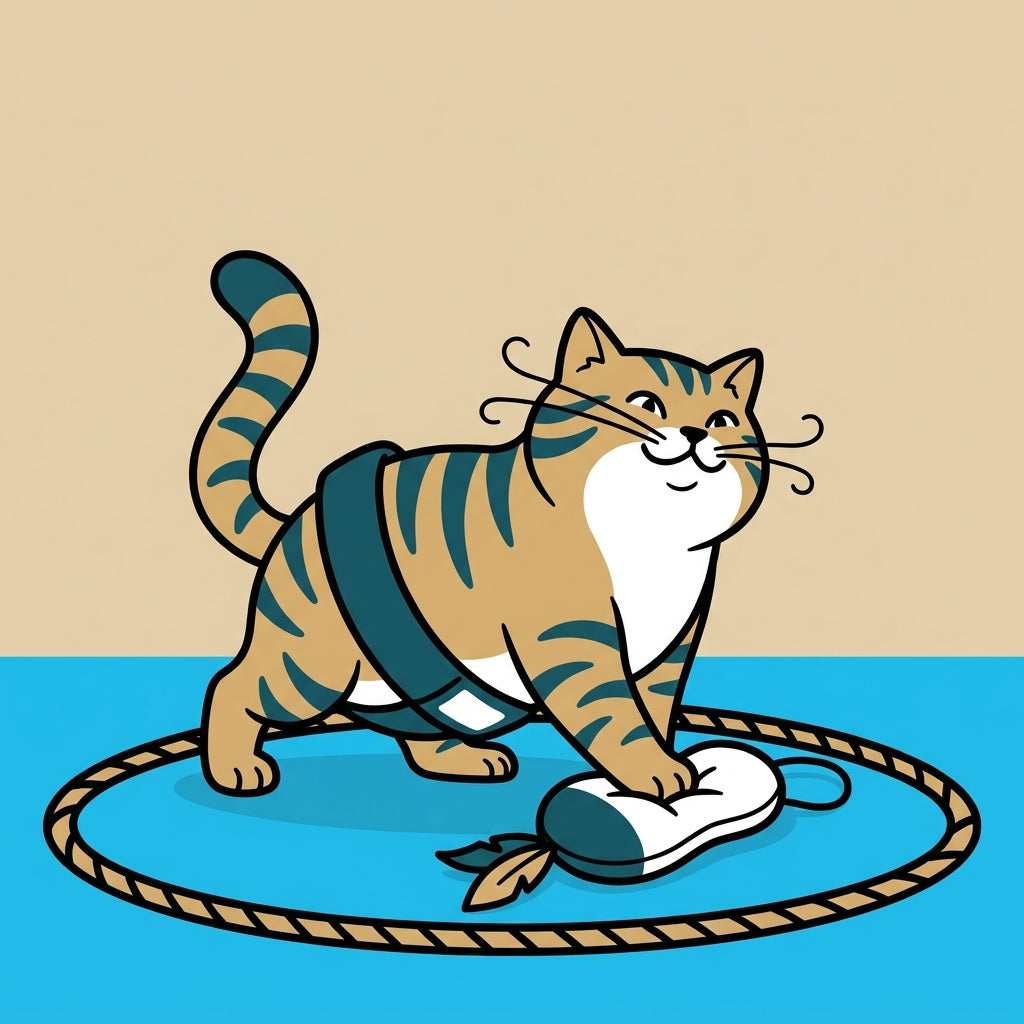
CATSUMO™ Wrestler
A wearable "opponent" built for exactly this kind of quick, high-intensity round, so your cat gets a real match instead of a half-hearted swat at a string. See the Wrestler →

CATSUMO Dohyo Wrestling Mat
Gives that burst of energy a defined ring to happen in — and once the bout's over, it doubles as a soft spot for your cat to collapse into recovery mode right where the match ended, corner and all. See the Dohyo Mat →
Neither product changes how much your cat sleeps, and they're not meant to — the sleep is doing exactly what it should. The pitch is just timing: a well-placed match during a natural wake window turns "why is my cat asleep all day" into "my cat had a great round and is recovering like a champion."
FAQ: cats and sleep
Why do cats sleep so much during the day?
It's an inherited energy-conservation instinct from their hunting ancestry. Hunting comes in short, high-effort bursts that don't always succeed, so cats evolved to bank energy through frequent rest rather than stay moderately active all day.
How many hours a day do cats normally sleep?
Most adult cats sleep roughly 12–16 hours a day, with the wider normal range landing between about 12 and 18 hours. It's rarely one long stretch — expect several shorter naps spread across day and night.
Is it bad for my cat to sleep almost all day?
Generally, no — 12–18 hours is within the normal range for a healthy adult cat. It's worth paying attention to changes rather than the total number: a sudden jump or drop in sleep, or sleep paired with other new symptoms, is a better reason to check in with your vet than the raw hour count on its own.
What's the difference between a cat's catnap and deep sleep?
A catnap is light, short rest (often 15–30 minutes) where a cat stays semi-alert and can react quickly. Deep sleep is less frequent and harder to wake a cat from — it's when you're most likely to see twitching paws, a flicking tail, or fluttering whiskers, which are generally associated with dreaming.
Do kittens and senior cats sleep more than adult cats?
Yes, typically. Kittens can sleep up to about 20 hours a day to support rapid growth and development, while senior cats (roughly 10 years and up) often sleep more than a typical adult cat as activity naturally slows with age.
What's the best time of day to play with a cat, based on their sleep cycle?
Early morning and early evening — the dawn and dusk windows when cats are naturally most active as crepuscular animals. A short, focused play session in one of these windows usually lands better than trying to rouse a napping cat midday.
Should I be concerned if my cat's sleep habits suddenly change?
A gradual increase with age is normal. A sudden change — sleeping noticeably more or less than usual, especially alongside appetite changes, weight loss, hiding, or reduced activity when awake — is worth a veterinary visit to rule out an underlying health issue.
Sources
- [1] PetMD (vet-reviewed) — Why Do Cats Sleep So Much?
- [2] Wikipedia, "Cat behavior" — Sleeping patterns
- Cornell Feline Health Center — General feline health resources
This article is for general educational purposes and is not a substitute for individualized veterinary advice. If your cat's sleep habits change suddenly or are paired with other new symptoms, talk to your veterinarian.


Leave a comment
This site is protected by hCaptcha and the hCaptcha Privacy Policy and Terms of Service apply.