

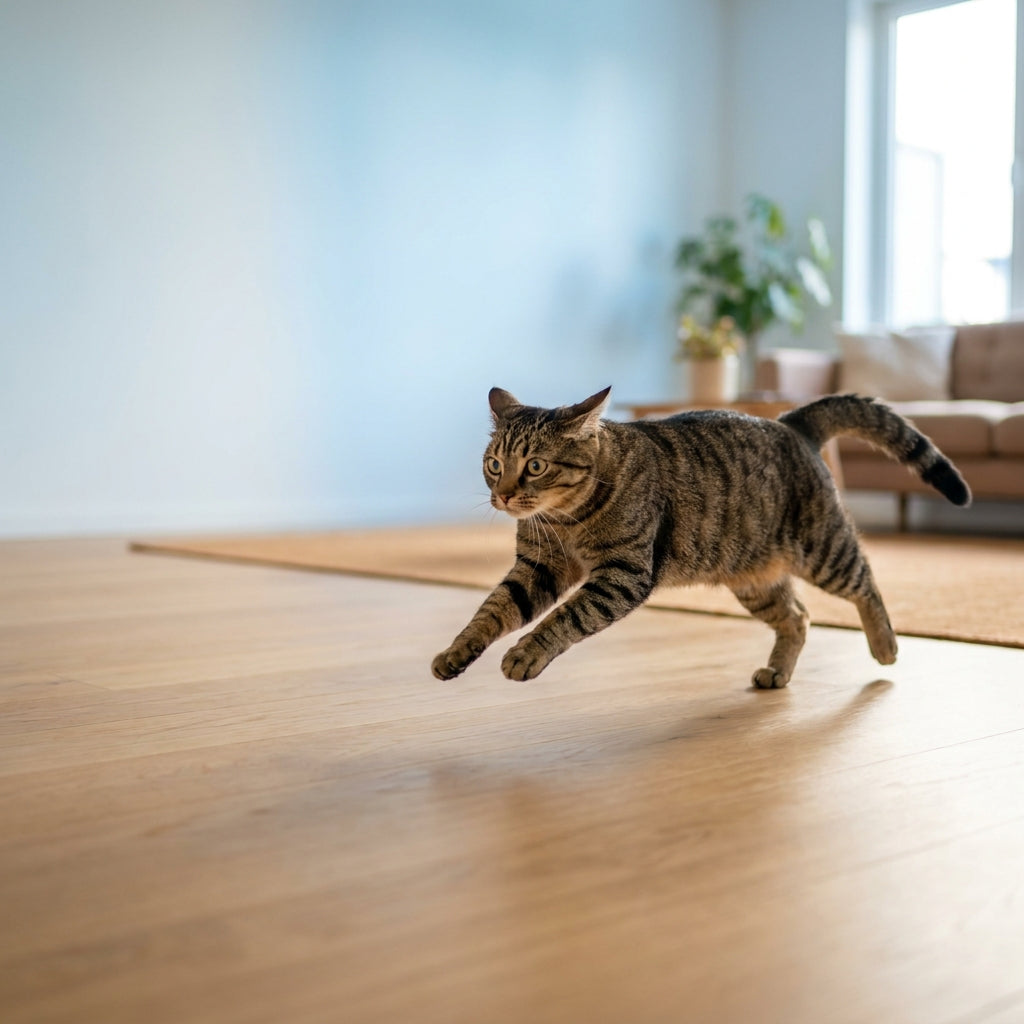
Cat zoomies — those sudden bursts of sprinting, pouncing, and skidding around furniture — are a well-documented, normal feline behavior called a FRAP (Frenetic Random Activity Period). They're a quick release of built-up energy tied to your cat's natural hunting instincts, most common at dawn, dusk, and after naps or litter box trips. In healthy cats, zoomies are nothing to worry about — just energy that needs somewhere to go.
On this page
What are cat zoomies, really?
"Zoomies" is the informal, internet-famous name for what animal behaviorists call a Frenetic Random Activity Period, or FRAP. It describes a short episode — usually somewhere between 30 seconds and a few minutes — where a cat suddenly sprints, leaps, spins, pounces at nothing, and generally acts like they've been possessed by a tiny, furious ghost.
FRAPs aren't unique to cats. Dogs, ferrets, and even rabbits have their own versions (dog owners often call theirs "frenzies" or "the crazies"). In cats specifically, the behavior tends to show up as a full-body sprint, often ending in a dramatic pounce, a skid around a corner, or a flying leap onto (or off of) furniture.
The key thing to understand up front: a FRAP is a release, not a malfunction. It's your cat's nervous system cashing out a build-up of energy in one quick, chaotic burst.
Why it happens: the instinct under the chaos
Zoomies look random, but there's a real behavioral logic underneath them. A few overlapping factors are usually at play.
A crepuscular hunting rhythm
Domestic cats are crepuscular, meaning their activity naturally peaks around dawn and dusk — the low-light hours when their wild ancestors would have been hunting small prey. That inherited rhythm doesn't disappear just because dinner now shows up in a bowl. Many cats still get a hardwired surge of alertness and energy right around sunrise or sunset, and if there's no actual mouse to chase, a lap around the living room (or your bed, at 3am) is the next best outlet.
Pent-up predatory and play energy
Indoor cats are safe from cars and predators, but that safety comes at a cost: fewer opportunities to stalk, chase, and pounce the way an outdoor hunting cat would across a normal day. When that predatory motor pattern doesn't get used, it tends to build up and then discharge all at once — which is exactly what a zoomie looks like. Think of it as pressure finding a release valve, whether or not there's an actual "reason" in the moment.
The post-litter-box connection
Many cat parents notice zoomies happen right after their cat uses the litter box. There's no single confirmed cause, but a few working theories are widely discussed by veterinarians and behaviorists: relief and a burst of energy after finishing (similar to how some cats vocalize or run after defecating), a possible instinctual urge to move quickly away from a vulnerable, exposed moment, or simple nerve stimulation during elimination. None of these are proven as the single explanation — it's most likely a mix, and it's common enough to be considered normal.
Kittens vs. adult and senior cats
Kittens tend to zoom more often and more intensely than adult cats, largely because they have more raw energy, less impulse control, and a stronger drive to practice hunting and play skills through repetitive chasing and pouncing. Zoomies usually taper off — but rarely disappear completely — as cats mature. A senior cat who suddenly starts having frequent, intense zoomies for the first time (especially alongside other new behaviors) is a slightly different situation than a kitten doing what kittens do; more on that in the vet section below.
Common zoomie triggers
Zoomies can seem to come out of nowhere, but they usually cluster around a handful of predictable moments:
- Dawn or dusk — the crepuscular energy spike described above
- Right after waking from a nap — stored-up energy with nowhere to go yet
- Immediately after the litter box — the "post-poop zoomies" many cat parents know well
- After a bath or grooming session — a stress-and-relief release once it's over
- Plain boredom or under-stimulation — especially in indoor-only cats with limited enrichment
- Late evening, right before your bedtime — dusk-adjacent timing that can feel personal, but usually isn't
Normal zoomies vs. when to call your vet
Most zoomies are completely normal and don't need any intervention beyond a bit of patience (and maybe closing the bedroom door at 3am). That said, a quick gut-check on context is worth it.
Consider mentioning it to your veterinarian if zoomie-like episodes show up alongside any of the following:
- Limping, stumbling, or obvious discomfort during or after the sprint
- Crying out or vocalizing in apparent pain, rather than normal play chirps or meows
- A sudden change in frequency or intensity that doesn't match your cat's usual pattern, especially in an older cat
- Zoomies paired with other new symptoms — changes in appetite, weight, thirst, or litter box habits
This article is for general education only and is not a substitute for veterinary advice. It cannot diagnose your cat. If something feels off, your veterinarian is always the right call.
Working with the zoomies instead of against them
You can't (and shouldn't try to) train the zoomies out of a cat — that instinct isn't going anywhere. But you can shape where and how that energy gets spent, instead of just white-knuckling it through another 3am sprint around the couch.
A few approaches that tend to help:
- Schedule play sessions before the usual zoomie windows. A 10–15 minute wand-toy or chase session in the early evening can burn off some of the energy that would otherwise fire off later on its own.
- Give the sprint a destination. Cats naturally look for something to pounce on at the end of a zoomie — a couch cushion, your ankle, a houseplant. Giving that instinct an actual target changes the outcome without fighting the instinct itself.
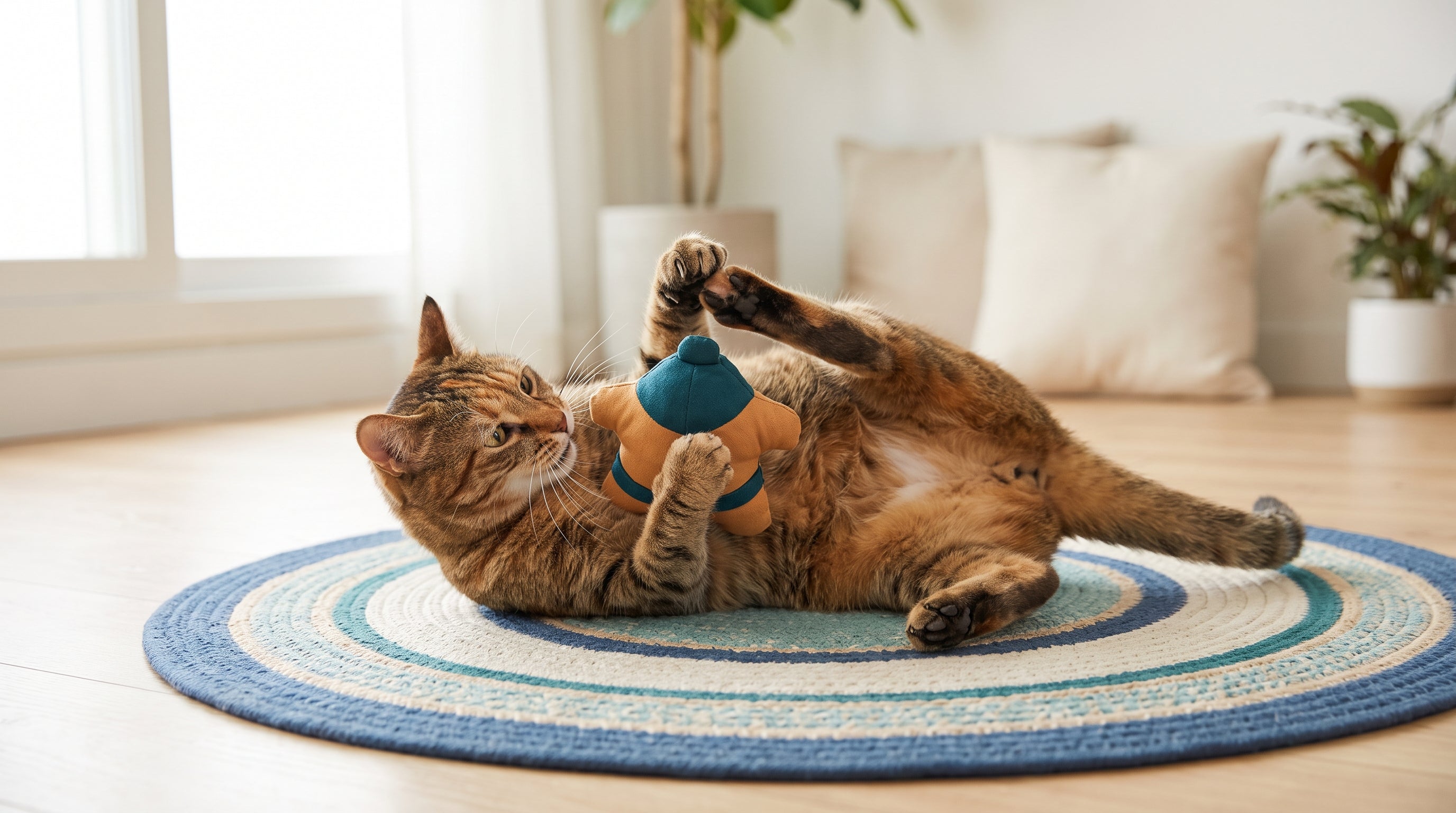
- Add a real "opponent" for supervised play. A lot of the chaos comes from a cat essentially wrestling an invisible opponent. Swapping the invisible opponent for a real one, in a play session you control, tends to redirect that energy more predictably than hoping it burns out on its own.
This is the exact idea behind CATSUMO's dohyo-and-wrestler setup: instead of the whole living room becoming the arena, your cat gets a defined ring and something to actually spar with. The CATSUMO Dohyo Wrestling Mat is a soft, grippy 27" x 27" ring that gives pouncing, swatting, and full-body wrestling a specific place to happen — "fight here, not there," instead of the rug, the cables, or your feet. Pair it with the CATSUMO Wrestler, a wearable cat toy that turns you into an actual sparring partner for supervised, hands-on play, rather than a bystander waiting for the sprint to end.

CATSUMO Dohyo Wrestling Mat
A defined 27" ring for zoomie energy to land in — soft, grippy, and easy to roll away when the match is over. See the Dohyo Mat →

CATSUMO Wrestler
An on-demand sparring partner, so zoomie energy has a real opponent instead of your ankles. See the Wrestler →
Want the full setup in one go? The CATSUMO Complete Dohyo Setup bundles the mat, the Wrestler, and a catnip refill pack together. None of this is a "cure" for zoomies — there isn't one, and there doesn't need to be. It's simply a more predictable outlet than hoping the couch survives another round.
FAQ: cat zoomies, answered
What exactly are "cat zoomies," and what is a FRAP?
Cat zoomies are short, intense bursts of sprinting, pouncing, and leaping, formally called a Frenetic Random Activity Period (FRAP). They typically last from under a minute to a few minutes and reflect a quick release of built-up energy rather than any kind of problem.
Is it normal for a cat to suddenly sprint and pounce around the house?
Yes. Sudden sprinting and pouncing episodes are a normal, common feline behavior seen across ages and breeds. They become worth a vet conversation only if paired with limping, pain, or other new symptoms, not on their own.
Why do cats get zoomies at night or early morning specifically?
Cats are crepuscular, meaning their ancestral hunting activity naturally peaks at dawn and dusk. That built-in rhythm often shows up as a burst of energy at those times, even for a well-fed indoor cat with nothing to hunt.
Why does my cat get the zoomies right after using the litter box?
Post-litter-box zoomies are common and not fully explained by one single cause. Leading theories include a rush of relief and energy after elimination, an instinctual urge to move quickly away from a vulnerable moment, and nerve stimulation — likely some combination of all three.
Do kittens get zoomies more than adult or senior cats?
Generally, yes. Kittens have more energy, less impulse control, and a stronger drive to rehearse hunting and play behaviors, so their FRAPs tend to be more frequent and intense. Zoomies usually taper off with age but rarely stop completely.
Are zoomies ever a sign of a health problem I should ask my vet about?
Usually not, but bring it up with your veterinarian if zoomies come with limping, pain vocalizations, a sudden change from your cat's normal pattern, or other new symptoms like appetite or litter box changes. This is general education, not a diagnosis.
Should I join in and play during a zoomie episode, or just let it run out?
Either is fine for an occasional zoomie. If they happen often or at inconvenient times, it's usually more effective to schedule play sessions ahead of the typical trigger windows (like early evening) rather than trying to intervene mid-sprint.
How can I redirect zoomie energy into something more predictable?
Regular scheduled play, an outlet designed for pouncing and wrestling, and a "real opponent" for supervised play (rather than furniture or ankles) all help shift the energy somewhere more useful and less chaotic over time.
Sources
- PetMD — Why Do Cats Get the Zoomies?
- Wikipedia — Frenetic Random Activity Periods
- Cats.com — Why Do Cats Get the Zoomies & When to Call Your Vet
- Village Vet — Cats and The Zoomies: Understanding Frenzied Feline Fun
This article is for general educational purposes and does not replace individualized veterinary advice.

Leave a comment
This site is protected by hCaptcha and the hCaptcha Privacy Policy and Terms of Service apply.