

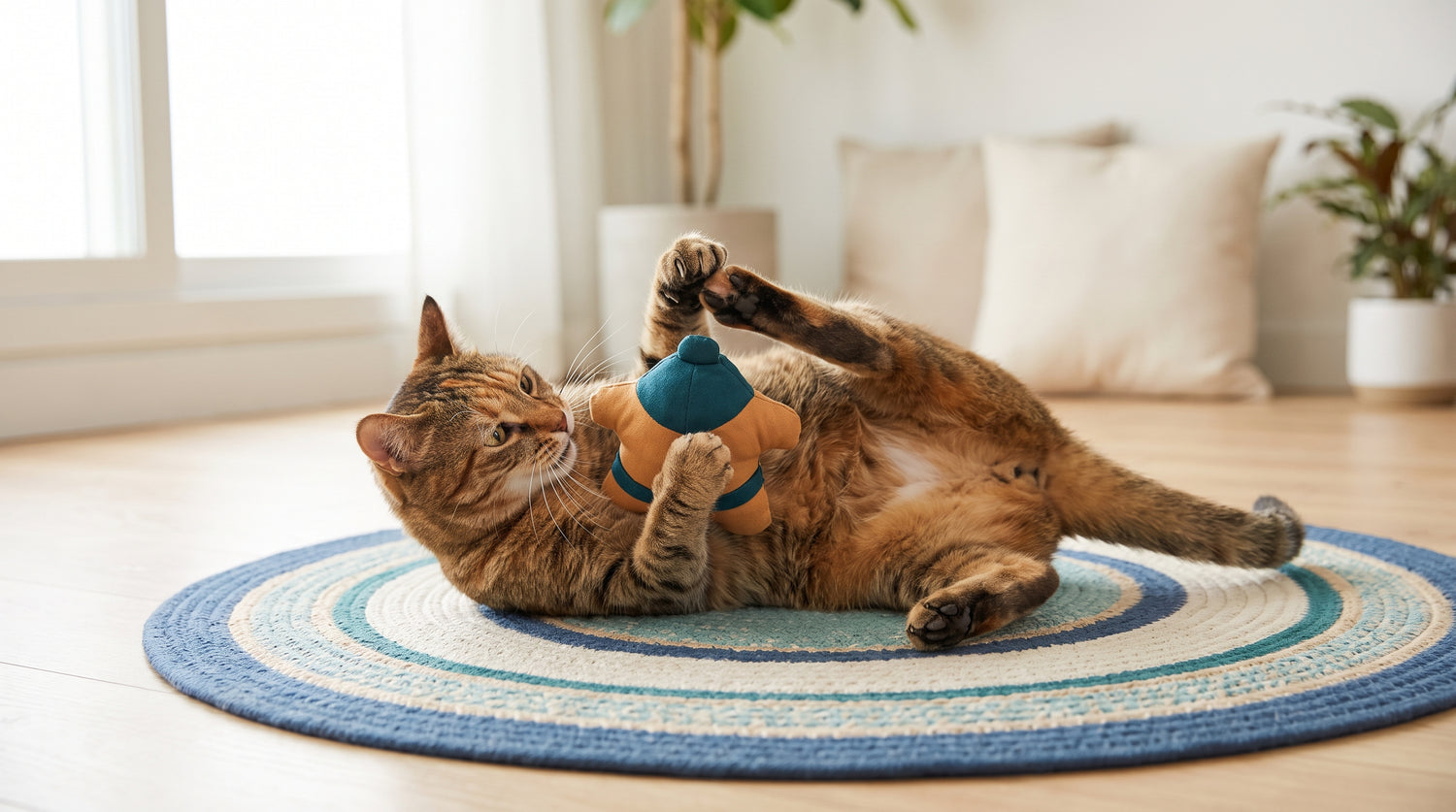
Most "aggressive-looking" play is completely normal. Bunny kicks, ambush pounces, and hard mouthing are rehearsals of a cat's built-in hunting sequence — stalk, chase, pounce, bite/kick — not a sign your cat hates you. You can usually tell play from real aggression in seconds by checking ears, tail, claws, sound, and how fast your cat "resets" afterward. This guide breaks down both, plus how to redirect the rough stuff safely.
On this page
- What "play aggression" actually is
- Quick-scan checklist: play signals vs. aggression signals
- A related pattern: petting-induced (overstimulation) aggression
- Why hands and ankles become the target
- The fix: give the sequence a consistent "body double"
- When to loop in your vet or a cat behavior consultant
- FAQ: cat play vs. aggression, answered
- Sources
What "play aggression" actually is
"Play aggression" is a slightly confusing name for a completely normal behavior: a cat rehearsing its predatory motor pattern on a person, hand, ankle, or another pet instead of actual prey. That pattern — stalk → chase → pounce → bite or kick — is hardwired into every cat, indoor or outdoor, fed or not. It doesn't come from anger. It comes from instinct that has nowhere else to go.
According to VCA Animal Hospitals, play aggression is most common in kittens and young cats, especially those who were orphaned, weaned early, or raised without littermates to practice on. Littermate play is where kittens normally learn bite inhibition — how hard is too hard — through instant feedback (a hiss, a smack, a game that stops). A kitten who missed that schooling often keeps testing the same limits on human hands well into adulthood, simply because nothing ever taught them otherwise.
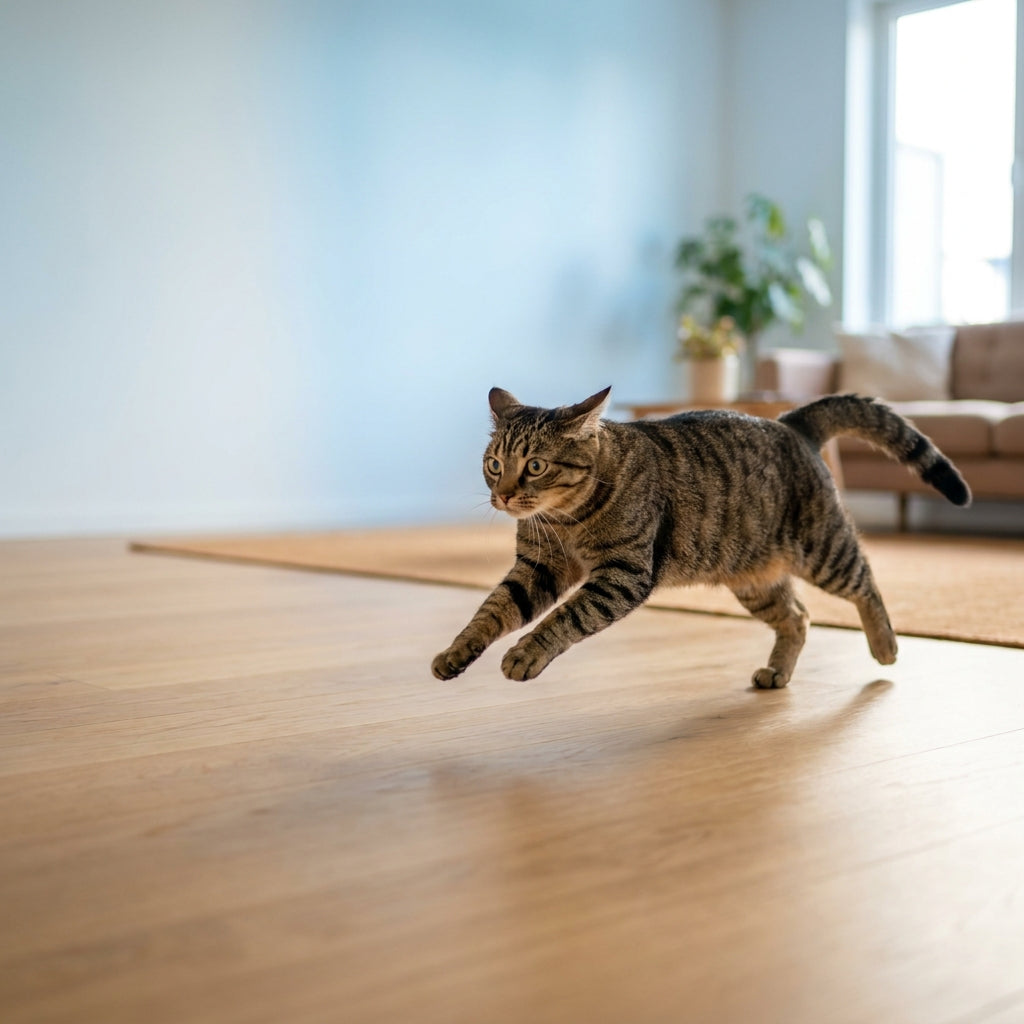
The behavior itself looks dramatic: a low crouch and twitching tail (the "stalk"), a sudden low-speed sprint (the "chase"), an ambush from behind furniture (the "pounce"), and then a grab-and-kick or a quick bite (the "bite/kick"). The famous bunny kick — where a cat grabs an arm or a toy with its front paws and rapid-fires its back feet — is the exact motion a cat would use to disembowel prey. It looks intense because it's meant to be effective, not because your cat is upset with you.
Quick-scan checklist: play signals vs. aggression signals
Most cats give clear body-language clues about which mode they're in. Use this table to sanity-check what just happened.
No single signal is 100% diagnostic on its own — read the combination, and trust a fast "reset" as one of the most reliable clues that it was play. Catster's vet-reviewed guide and the Cornell Feline Health Center both point to this same cluster of body-language cues for telling the two apart.
A related but distinct pattern: petting-induced (overstimulation) aggression
Sometimes a cat who was calmly enjoying pets suddenly bites or swats and stalks off — with no chase, no pounce, and no obvious "game" beforehand. This is usually petting-induced aggression, also called overstimulation aggression, and it isn't the same mechanism as play aggression. It tends to happen after repetitive stroking crosses a cat's individual tolerance threshold, and it's often preceded by subtle warnings: tail flicking or thumping, skin rippling along the back, ears rotating back, or the cat going still. VCA Animal Hospitals recommends watching for those early cues and pausing petting before the threshold is crossed, rather than pushing through to "finish" the pet.
Why hands and ankles become the target
Hands and ankles are, biomechanically, the most prey-like things in a house. They're low to the ground, they move quickly and unpredictably, and — crucially — they tend to react. A twitching hand under a blanket or a foot darting past a doorway triggers the exact same visual "prey" cues a mouse or bird would, especially for a cat whose predatory circuitry is still fully switched on and under-exercised.
Kittens are especially prone to this for a simple reason: they're still calibrating bite inhibition, and human hands are often the only "prey" readily available to practice on. Every time a hand darts away, swats back, or otherwise "plays along," it reinforces the chase from the cat's point of view — even if the human's intent was just to stop the behavior. Certified cat behavior consultant Pam Johnson-Bennett notes that hand-play, however tempting in the moment (a tiny kitten mouthing your finger is genuinely cute), is one of the most common ways owners accidentally train a cat that hands are a legitimate toy — a habit that gets a lot less cute at 10 pounds with adult teeth and claws.
The fix: give the sequence a consistent "body double"
You can't train the predatory sequence out of a cat, and you shouldn't try — stalk-chase-pounce-bite/kick is core to who they are. What you can do is change the target. The most reliable fix, backed consistently across veterinary and behaviorist sources, is redirection, not punishment.
Physical corrections — swatting back, scruffing, spray bottles, yelling — tend to backfire. They can make a cat more anxious around hands (which paradoxically increases defensive aggression) or simply teach the cat that hands are unpredictable, without ever addressing the actual instinct driving the behavior. Both VCA and Cornell Feline Health Center are consistent on this point: punishment doesn't resolve play aggression, it just adds fear to the mix.
What works better is a two-part approach:
- Interrupt without engaging. The instant play turns into a hand- or ankle-grab, go still and boring — no yelling, no yanking away fast (which reads as more prey-like movement), just a calm pause until your cat lets go, then quietly disengage.
- Give the sequence a consistent, dedicated target. This is the part that actually prevents the next incident instead of just reacting to the last one. If hands and ankles stop being the only "moving prey" around, they stop being the default target.
This is exactly the idea behind CATSUMO's wrestling setup. Instead of your hand playing body double for prey, a wearable target does the job on purpose, every time — so your cat has a legitimate, satisfying outlet for the exact stalk-chase-pounce-bite/kick sequence it's wired to run, without your skin footing the bill.

CATSUMO Wrestler
A wearable "body double" for your hand, so bunny kicks and bite play land on a designed target instead of your skin. See the Wrestler →
Two small details make redirection actually stick over time. First, novelty matters: a toy loses its "prey" appeal fast once the catnip inside goes stale, which is often why a redirection tool works great for a week and then quietly gets ignored. Keeping the CATSUMO Catnip Refill Pack on hand keeps the Wrestler more interesting than a hand, long after the first sachet fades — though it's worth remembering that not every cat responds strongly to catnip; some cats are simply indifferent to it, and that's normal too. Second, a defined space helps keep rough play from sprawling across the whole house. The CATSUMO Dohyo Wrestling Mat gives redirected wrestling matches an actual ring — a consistent "this is where we play rough" zone instead of the rug, the cables, or your ankles.

CATSUMO Dohyo Wrestling Mat
A defined 27" ring so wrestling matches have a home base — instead of spreading across the whole living room. See the Dohyo Mat →
None of this is a "cure" for play aggression — there isn't one, because it isn't a malfunction to begin with. It's simply giving an unstoppable instinct a better place to land than your ankles.
When to loop in your vet or a cat behavior consultant
Most rough play, bunny kicks, and even the occasional hard nip fall well within normal range and respond to redirection over a few weeks. Some patterns are worth a professional opinion instead of more DIY troubleshooting.
Consider talking to your veterinarian or a certified cat behavior consultant if you notice:
- Aggression that shows up outside of play contexts — unprovoked attacks, aggression when picked up or handled, or aggression tied to specific body areas (which can point to pain)
- A sudden change in intensity or frequency that doesn't match your cat's normal pattern
- Bites that consistently break skin or draw blood, rather than inhibited "mouthing"
- Ongoing tension or aggression between multiple cats in the household, not just human-directed play
- No improvement after several weeks of consistent redirection and interrupted play sessions
This article is for general education only and is not a substitute for veterinary or behavioral diagnosis. It cannot assess your individual cat. If something feels off — especially sudden changes in behavior — your veterinarian or a certified feline behavior consultant is the right next call.
FAQ: cat play vs. aggression, answered
How can I tell if my cat is playing or actually being aggressive?
Check ears, tail, claws, sound, and recovery time. Play usually shows forward or neutral ears, a twitching (not lashing) tail, sheathed claws, silence or chirps, and a fast return to calm behavior. True aggression usually shows flattened ears, a puffed or thrashing tail, extended claws, hissing or growling, and lingering tension afterward.
What is "play aggression" in cats?
Play aggression is a cat rehearsing its natural predatory sequence — stalk, chase, pounce, bite or kick — on a person, hand, foot, or other pet instead of real prey. It's an instinct-driven behavior, not hostility, and it's especially common in kittens and young or under-stimulated cats.
Why does my cat bite and bunny-kick so hard during play?
The bunny kick is the same rapid-fire hind-leg motion a cat would use to disembowel prey it's grasping with its front paws. It's meant to be effective, which is why it looks and feels intense, even though it's a normal part of feline play rather than a sign of anger.
Is bunny kicking a sign of aggression or just normal play?
On its own, bunny kicking is normal predatory play, not aggression. Look at the surrounding signals — relaxed ears, quiet or playful vocalizing, and a quick reset afterward point to play; flattened ears, hissing, and lingering tension point toward real aggression instead.
Why does my cat suddenly bite after I've been petting them?
This is usually petting-induced (overstimulation) aggression, not play aggression. It happens when repetitive petting crosses an individual cat's tolerance threshold, often after subtle warning signs like tail flicking, skin rippling, or ears rotating back that were easy to miss.
Does letting my cat play rough with my hands make them more aggressive over time?
It can reinforce hands as an acceptable "prey" target, especially in kittens still building bite inhibition. It doesn't make a cat generally more aggressive, but it does make hands a more likely target for future rough play until a consistent alternative is introduced.
How do I stop my cat from attacking my hands or ankles during play?
Stop engaging the moment it happens (go still and boring rather than yanking away), avoid punishment, and give the predatory sequence a consistent alternative target — like a wearable toy — so hands and ankles stop being the default "prey" option.
When should I actually be concerned and talk to a vet or behaviorist?
Reach out if aggression happens outside of play, intensifies suddenly, involves bites that consistently break skin, seems tied to pain or handling, or doesn't improve after a few consistent weeks of redirection. A professional can rule out pain or medical causes that redirection alone won't fix.
Sources
- VCA Animal Hospitals — Play and Predatory Aggression in Cats
- VCA Animal Hospitals — Cat Behavior Problems: Petting Aggression
- Cornell Feline Health Center — Feline Behavior Problems: Aggression
- Catster (vet-reviewed) — Play Aggression in Cats: Signs, Causes & Solutions
- Cat Behavior Associates (Pam Johnson-Bennett, certified cat behavior consultant) — How to Stop Play Aggression in Cats
- PetMD — Why Do Cats Bunny Kick?
This article is for general educational purposes and does not replace individualized veterinary or behavioral advice.

Leave a comment
This site is protected by hCaptcha and the hCaptcha Privacy Policy and Terms of Service apply.