

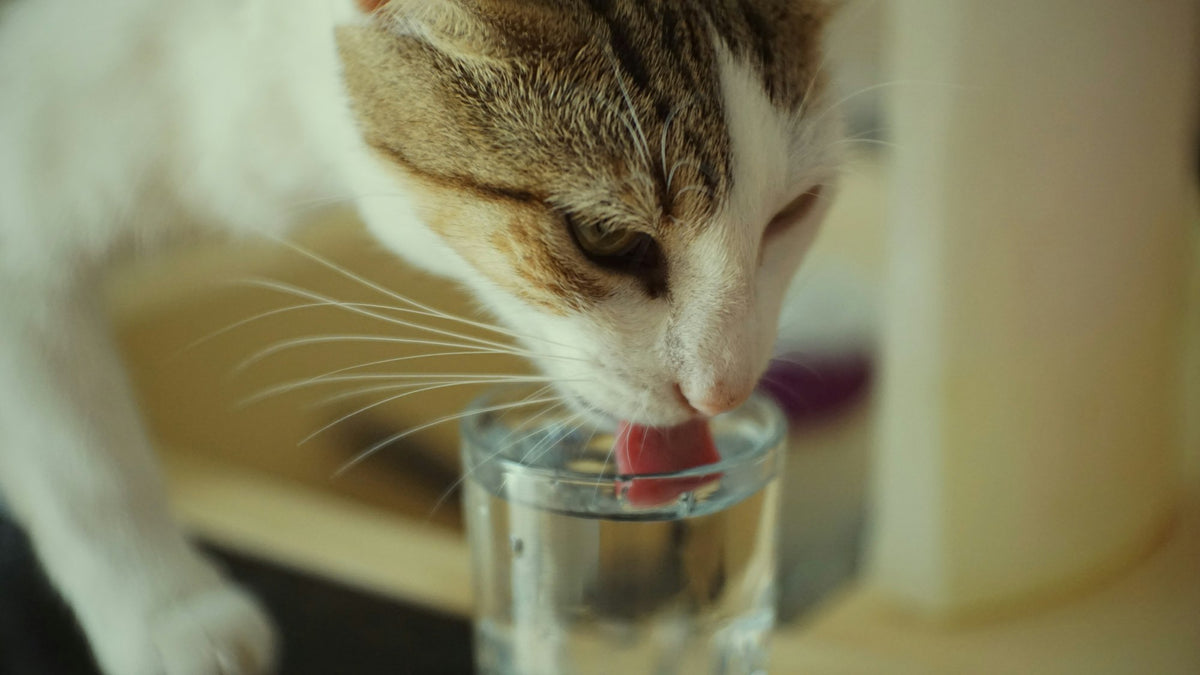
Cats knock things off tables because their whiskers and paws are wired to test almost everything they touch — it's leftover predatory "manipulation" behavior, not spite. A mug at the counter's edge gets the same investigative tap a mouse would get in the wild. Layer in boredom or a little attention-seeking, and that single paw-tap turns into your nightly soundtrack.
On this page
The paw-first science behind the chaos
Before anything hits the floor, two sensory tools are already doing the work: whiskers and paws.
Whiskers take the first pass
A cat's whiskers (vibrissae) are rooted in bundles of nerve endings called follicle-sinus complexes — among the most touch-sensitive hair follicles in mammals. They don't just register contact; they pick up tiny shifts in air currents, which helps a cat judge an object's size, distance, and movement before a paw ever gets involved. That's especially useful up close, where a cat's eyesight is actually at its weakest.
Paws finish the investigation
Paw pads carry a dense concentration of touch receptors, and a light bat or press against an object gathers the same kind of information a nose or eye would: texture, weight, whether it wobbles, rolls, or fights back.
That reflex traces straight back to hunting mechanics. International Cat Care describes a set predatory sequence cats run through when hunting: search, locate, approach/stalk, capture, kill, manipulate, and consume. The "manipulate" step — pawing at, turning over, and testing a catch before eating it — is essentially the same move your cat runs on a pen, a hair tie, or a coffee mug. Researchers who study cat play note that when adult cats bat around the toys (or random objects) we provide, they're essentially performing predatory behavior directed at something that isn't actually prey.[1] A tabletop knick-knack just happens to check enough of the "possible prey" boxes — small, loose, capable of sudden movement — to get flagged for a test swat.

A single paw-tap gathers the same info a nose or eye would: texture, weight, whether it moves back.
3 types of knock-offs: curiosity, play, or attention
Not every knock-off is running the same play. Think of yourself as the referee — once you can read the tells, you'll know exactly which round you're watching.
| Knock-off type | What it looks like | What's driving it |
|---|---|---|
| Curiosity Test | One slow, deliberate paw-tap. Ears and whiskers forward, calm tail, cat watches the object roll or fall with mild interest. | A new or unfamiliar object getting a routine "what is this" check. |
| Play Pounce | Fast, full-body swipe or pounce, sometimes with a low crouch first and a chase after it lands. Tail may lash or twitch mid-air. | Stored hunting/play energy — more common when a cat is under-stimulated or hasn't had a play session that day. |
| Attention Grab | Repeated swats paired with direct eye contact toward you, often a pause-and-watch-your-reaction pattern. | A learned move that reliably gets you to look up, talk, or come over. |

Three different plays, three different tells.
A single sitting can run more than one type back to back — a Curiosity Test that gets you laughing or grabbing your phone can graduate into an Attention Grab the next time your cat wants eyes on them.
Do kittens do this more than adult cats?
Often, yes — though it rarely disappears entirely with age. Kittens develop most of their predatory motor patterns in a fairly narrow window, roughly between 4 and 12 weeks old, and it's during this stretch that object-directed play and true hunting behavior start running through the same underlying control systems.[2] A kitten batting a bottle cap across the kitchen floor for the tenth time isn't being extra; it's rehearsing.
Adult cats keep the wiring, they just tend to use it more selectively. Research on adult object play has found that cats show more intense, longer play sessions with toys that resemble real prey, and that hungrier cats play harder and longer with objects — both signs that adult cats still process batting an object as a form of predatory behavior, not "just" a habit they never grew out of.[1] In practice, that means a bored or under-stimulated adult cat can absolutely knock as much off your counter as a kitten does — the testing instinct never really retires.
How to redirect the energy without punishing curiosity
Paw-testing is normal, healthy behavior — the goal isn't to shut it off, it's to give it somewhere better to land.
- Clear the "testable" small stuff off edges. Pens, hair ties, jewelry, and anything light enough to roll are the most tempting targets. Move them off counters and tabletops rather than trying to train the instinct away.
- Keep heavier, top-weighted items away from the edge. A few inches back is often enough to remove the easy strike zone.
- Add short, frequent play sessions. International Cat Care specifically recommends short, frequent interactive play sessions using prey-like toys as a welfare-friendly way to give cats an outlet for predatory energy — this is especially worth trying if your cat's knock-offs look more like Play Pounce or Attention Grab.[1]
- Don't reward the Attention Grab loop with a big reaction. Yelling, chasing, or even laughing loudly can accidentally teach a cat that knocking something over is the fastest way to get you moving. A calm, low-key response (redirect to a toy, brief ignore) removes the payoff without any punishment.
- Give paws a "yes" surface. A scratching post, window perch, or a toy built to be batted and gripped gives the same instinct a legal target.
When to loop in your vet: Occasional paw-testing and the odd knocked-over cup are normal cat behavior. A sudden increase in destructive behavior, or a cat that seems unsteady, disoriented, or is knocking things over because they're misjudging distance, is worth a veterinary check — this article is general education, not a diagnosis, and changes like that are better questions for your vet than for the internet.
Give the batting instinct a designated ring
Since paw-testing, pouncing, and the occasional attention-seeking swat are all hardwired, the fastest fix usually isn't stopping the behavior — it's relocating it to something built to take the hit.

CATSUMO Wrestler
A durable, wearable "opponent" that gives repeated batting and pouncing a real target — your gloved hand — instead of the nearest countertop object. See the Wrestler →

CATSUMO Dohyo Wrestling Mat
A defined 27" ring — per its own product description, it "gives that energy somewhere to go" — so Play Pounce and Attention Grab sessions land on the mat instead of the counter. See the Dohyo Mat →
Neither product is a guaranteed fix for a chronic knocker-over — no toy is. They're simply an easy, repeatable outlet for an instinct that isn't going anywhere, so the chaos has a ring to land in instead of your kitchen floor.
FAQ: cats and counter chaos
Why does my cat knock things off tables and counters?
Mostly leftover predatory "manipulation" behavior — the same paw-testing, turning, and batting cats use on real prey — redirected onto small, loose household objects. Boredom and attention-seeking can pile on top of that base instinct.
Is my cat doing this on purpose, or is it instinct?
Both, depending on the moment. The underlying paw-testing and pouncing motions are instinctive, but a cat can absolutely learn — on purpose — that knocking something over gets a fast, reliable reaction out of you.
Do cats actually test objects with their paws before they fall?
Often, yes. A light, deliberate tap that checks how an object moves or feels is a common first step, especially with new or unfamiliar items. A fast, committed pounce with no test tap first usually means play or hunting instinct has already taken over.
Is knocking things off surfaces a sign of boredom or attention-seeking?
It can be either — or neither. A single curious tap on something new is normal exploration. Repeated knock-offs during otherwise quiet stretches of the day often point to boredom or under-stimulation, while knock-offs paired with direct eye contact and repetition are usually attention-seeking.
Do kittens do this more than adult cats?
Often, since kittens are actively developing predatory motor skills between roughly 4 and 12 weeks of age and practice heavily on objects. Adult cats keep the same wiring and will readily bat objects around too, especially when under-stimulated or hungry.
How can I stop my cat from knocking things off counters without punishing curiosity?
Manage the environment first — clear tempting small objects off edges — then add more short, interactive play sessions and avoid big reactions that accidentally reward the behavior. Physical punishment isn't recommended; it doesn't remove the instinct and can damage trust.
What can I give my cat to bat/knock around instead of my belongings?
Toys built to be gripped, batted, and pounced on repeatedly — a wearable toy like the CATSUMO Wrestler, wand toys, or anything with texture and a bit of "give" — tend to hold up better than household objects and satisfy the same instinct.
When does this behavior mean my cat needs more enrichment or play?
If knock-offs are frequent, happen during otherwise idle hours, or ramp up right before or after you've been away, treat it as a signal your cat could use more daily interactive play or environmental enrichment (climbing space, window perches, puzzle feeders), not just a scolding.
Sources
- [1] International Cat Care — Understanding the Hunting Behaviour of Cats
- [2] Delgado, M.M., & Hecht, J. (2019). A review of the development and functions of cat play, with future research considerations. Applied Animal Behaviour Science.
- VCA Animal Hospitals — Why Do Cats Have Whiskers?
- ASPCA — Common Cat Behavior Issues
This article is for general educational purposes and is not a substitute for individualized veterinary or behavioral advice. If destructive behavior appears suddenly, or is paired with unsteadiness, disorientation, or other new symptoms, talk to your veterinarian.


Leave a comment
This site is protected by hCaptcha and the hCaptcha Privacy Policy and Terms of Service apply.