

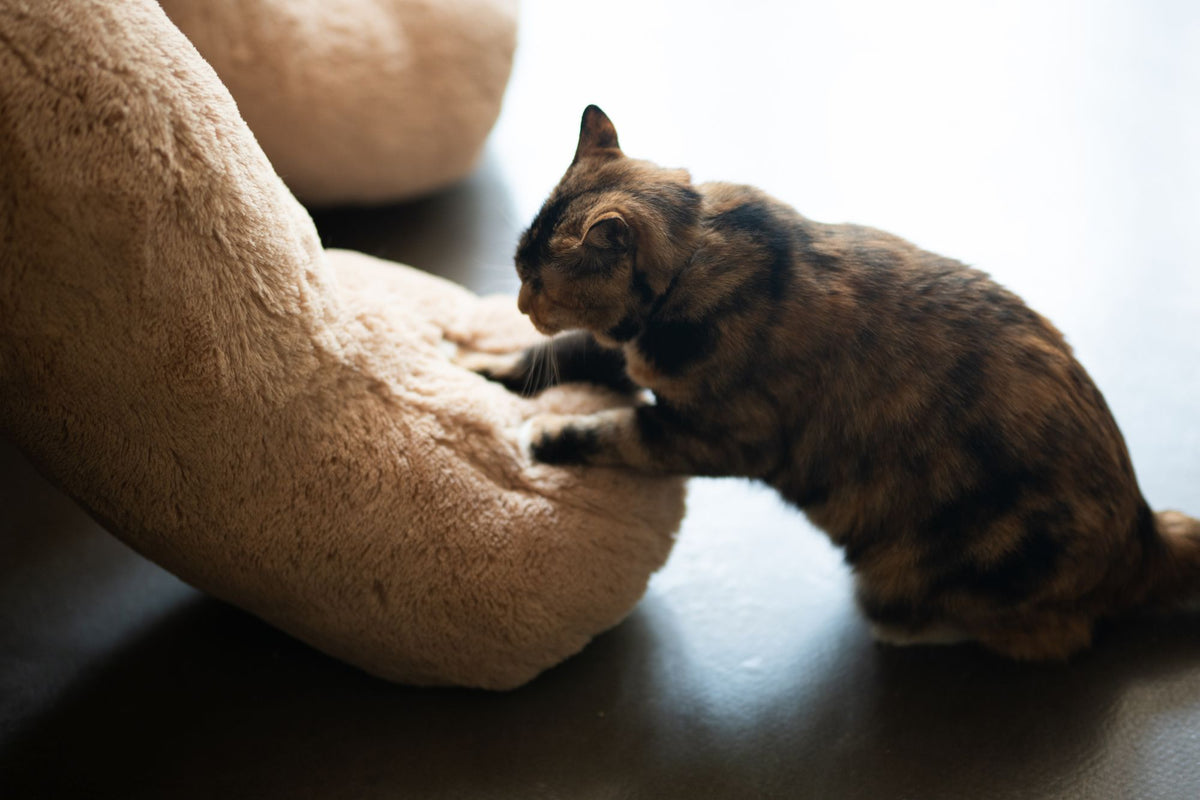
Kneading — the rhythmic paw-push cats do on blankets, laps, and you — is a leftover kitten nursing reflex. Most cats carry it into adulthood as a self-soothing comfort ritual: it releases feel-good brain chemicals, helps "fluff" a spot before sleep, and lets a cat mark what it kneads with scent glands in its paw pads. It's normal, it's affectionate, and — outside of a sudden new-onset case — it's nothing to worry about.
On this page
- What "kneading" actually is
- Where it comes from: the kitten nursing reflex
- Why adult cats keep doing it
- The scent-marking layer: paw pads and "claiming" you
- Kneading before sleep: prepping the nest
- Normal variation: not every cat kneads the same way
- When to just watch it vs. mention it to your vet
- Give the ritual its own ring
- FAQ: cat kneading
- Sources

Every cat's private warm-up ritual before settling into their own ring.
What "kneading" actually is
Kneading is a repetitive, rhythmic motion where a cat alternates pushing its front paws (sometimes all four) into a soft surface — a blanket, a couch cushion, your lap — over and over, similar to a baker working dough. That resemblance is exactly why it earned the nickname "making biscuits."
Some cats knead with their claws politely retracted. Others extend them with every push, which is why kneading can feel more like a gentle massage from one cat and mildly uncomfortable from another. Many cats also purr, drool a little, or half-close their eyes while doing it — all signs of a relaxed, contented state rather than distress.
Where it comes from: the kitten nursing reflex
Kneading starts almost as soon as a kitten is born. While nursing, kittens instinctively push their paws against their mother's belly to help stimulate milk flow — a reflex vets sometimes call "milk treading." According to PetMD, kittens use this kneading action to stimulate milk production from their mother while nursing, and because that time is also filled with a mother cat's warmth and calming pheromones, it gets strongly associated with comfort and security from the very start.[1]
That early pairing — paw-pushing plus feeling safe and cared for — is the seed of the adult behavior. The motion itself sticks around long after weaning, even though the original job (getting milk to flow) no longer applies.
Why adult cats keep doing it
Most adult cats aren't kneading to nurse — they're kneading to relax. Cats.com notes that with the behavior rooted in kittenhood, this repetitive motion can become a calming activity for cats and a way to release tension, which is why it so often shows up during quiet, contented moments: after a meal, mid-cuddle, or right before a nap.[2]
There's a chemical piece to this, too. PetMD explains that kneading triggers the release of dopamine, the same feel-good brain chemical tied to pleasure and reward, which both explains why kneading feels good to a cat and why some cats do it so enthusiastically and repeatedly.[1] Some cats will also knead and suckle on a blanket or soft fabric at the same time — a mash-up of the original nursing motion and the modern comfort ritual, both pointing at the same root: feeling safe.
The scent-marking layer: paw pads and "claiming" you
Cats have scent glands tucked between the pads of their paws. Every time a cat kneads a blanket, a cushion, or your leg, it's pressing a small amount of its own scent into that surface. PetMD points out that this allows a cat to mark its territory, in case other cats come sniffing around for resources to claim — which is also why kneading you specifically can be read as a compliment. Your cat isn't just comfortable with you; it's marking you as part of its world.[1]
Cats.com frames this the same way: kneading imparts some of a cat's personal scent onto whatever it kneads, effectively marking that spot — or that person — as its own.[2] Combine the scent-marking angle with the comfort angle, and a kneading session on your lap is doing double duty: soothing your cat and quietly telling the rest of the house (feline or human) that you're "theirs."
Kneading before sleep: prepping the nest
A lot of kneading happens in the minutes right before a cat curls up and dozes off — and that's not a coincidence. Cats.com notes that some animal behaviorists trace kneading back to wild cats tamping down grass and leaves to build a resting nest, and that domestic cats may still be running that same "fluff the bedding" instinct on blankets, cushions, and laps before settling in.[2]
It's a small, low-effort ritual: a few seconds of paw-pushing, a slow sink into a curled-up position, and then sleep. If your cat has a favorite pre-nap kneading spot, that's usually less about the exact fabric and more about the routine itself — the paw-push is the signal their own brain uses to start winding down.

Same motion, three life stages: nursing kitten, contented adult, pre-sleep nest-builder.
Normal variation: not every cat kneads the same way
If your cat has never kneaded a day in its life, or used to knead constantly as a kitten and doesn't anymore, that's within normal range — kneading is common, not universal. Some cats knead daily, some do it only in specific moods or spots, and some seem to skip the behavior almost entirely.
| Kneading style | What it looks like | Totally normal? |
|---|---|---|
| Claws-in kneading | Soft, gentle paw pushes with claws retracted the whole time. | Yes — the most common, comfort-driven style. |
| Claws-out kneading | Same motion, but claws extend with each push — can pinch skin or snag fabric. | Yes — some cats never fully retract; redirect to a blanket if it hurts. |
| Knead-and-suckle | Kneading paired with gentle sucking on a blanket, sleeve, or soft fabric. | Yes — an echo of nursing; usually harmless self-soothing. |
| No kneading at all | A cat that has never shown the behavior, or stopped after kittenhood. | Yes — kneading is common, not mandatory. No cause for concern on its own. |
When to just watch it vs. mention it to your vet
Ordinary kneading — the occasional biscuit-making session on a blanket, your lap, or a favorite cushion — is normal cat behavior and doesn't need any intervention. But both PetMD and Cats.com flag one pattern worth paying attention to: a sudden increase in how often or how intensely a cat kneads.
PetMD notes that increased or excessive kneading can be a sign that a cat is uncomfortable or anxious, using the behavior as a self-soothing attempt, and that cats experiencing soreness from an injury or arthritis may also knead to stretch their limbs and relieve muscle tension — its guidance is to consult your cat's veterinarian if kneading suddenly increases or seems excessive.[1] Cats.com echoes the same idea: kneading is usually associated with contentment, but if it's new or seems excessive, it's worth a conversation with your vet.[2]
When to loop in your vet: A cat that has always kneaded a little and still does is not a concern. A cat that suddenly starts kneading far more than usual, kneads with obvious discomfort, or shows other new symptoms (limping, hiding, appetite changes) is worth a veterinary check. This article is general education, not a diagnosis — always talk to your vet about changes specific to your cat.
Give the ritual its own ring
Since kneading is really a comfort-and-nesting behavior, the simplest way to support it is to give your cat a dedicated soft spot to do it on — something that feels good under the paws and holds up to regular claws-out sessions.

CATSUMO Dohyo Wrestling Mat
Its own product description calls it "soft enough to sink the toe beans in" — a no-pill fabric top cats want to grip, roll on, and nap on, that "doubles as a feeding or lounging mat between bouts." That combination of grip and softness makes it a natural spot for a pre-nap knead session, not just play. See the Dohyo Mat →
No mat will make a non-kneading cat start kneading, and no mat is a fix for anything medical — it's simply a soft, dedicated "ring" so your cat's comfort ritual has somewhere better to land than your favorite sweater.
FAQ: cat kneading
Why do cats knead with their paws?
It starts as a kitten nursing reflex used to stimulate milk flow from their mother, and most cats carry the motion into adulthood as a self-soothing comfort behavior tied to relaxation and dopamine release.
What does it mean when a cat kneads you?
It's generally a sign of comfort, trust, and affection — the same motion a kitten used with its mother — plus a bit of scent-marking through the glands in their paw pads, which is a cat's way of "claiming" you as part of its territory.
Why do cats "make biscuits" on blankets?
Soft, blanket-like surfaces trigger the comfort and nesting instincts behind kneading — the motion may help "fluff" bedding before sleep and lets a cat leave its scent on a favorite resting spot.
Is cat kneading a sign of affection?
Usually, yes. Kneading is rooted in the trust and closeness of nursing, and cats often knead people or spots they feel safe and relaxed with — though it's driven by self-soothing as much as by affection specifically. For the fuller picture of how cats show trust beyond kneading, see our guide on reading your cat's affection signals.
Why didn't my cat ever start kneading (or why did they stop)?
Kneading is common but not universal — some cats knead constantly, some rarely, and some seem to skip the behavior almost entirely. Not kneading is not a sign anything is wrong with your cat.
Can kneading be a sign of stress or discomfort in cats?
It can be. Kneading is generally a contentment behavior, but a sudden increase in frequency or intensity can signal self-soothing in response to stress, anxiety, or physical discomfort like joint soreness — that's the pattern worth mentioning to your vet.
Should I let my cat knead on me, and is it safe?
For most people, yes — it's a normal, affectionate behavior. If claws-out kneading is uncomfortable, place a thick blanket between your cat's paws and your skin, and keep nails trimmed rather than discouraging the behavior itself.
Sources
- [1] Hart, H., DVM. Why Do Cats Knead? PetMD, reviewed by Jennifer Coates, DVM.
- [2] Cats.com Editorial Team, updated by Youens, L., BVSc MRCVS. Why Do Cats Knead Their Owners? Cats.com.
This article is for general educational purposes and is not a substitute for individualized veterinary or behavioral advice. If kneading suddenly increases, becomes excessive, or appears alongside other new symptoms, talk to your veterinarian.



Leave a comment
This site is protected by hCaptcha and the hCaptcha Privacy Policy and Terms of Service apply.