

Owner's Guide
Getting Your Cat In The Ring
Owner's guide · 5 min read
It Moves, It Wrestles, and It Might Spook Your Cat at First
The Wrestler is a wearable puppet whose jaw and paws move with your hand. That unpredictability is what makes it thrilling once your cat trusts it, and it is also why some cats need a week to warm up. Here is how to get them there.

The Wrestler came out of the box, you slid it on, and your cat… left the room. Or stared from the doorway. Or gave it one dismissive sniff and went back to the radiator. If that's day one, nothing has gone wrong.
Cats don't evaluate new objects. They surveil them. A thing that appeared out of nowhere, smells like a warehouse, and is attached to the big primate they live with is a security matter first and a toy second. Every cat runs that assessment. Some take ten minutes. Some take a week.
So the goal of your first few sessions isn't play. It's lowering the threat rating. Everything below is built around that, and it works: the vast majority of cats who ignored the puppet on day one are wrestling it by the end of the week. The slow starters often turn into the most committed wrestlers of all.
Start here
Which cat is on your floor right now?
There are four ways this usually goes, and each one needs a different opening move. Tap the one that sounds like your cat.
Pick one above
Almost every cat gets to the same place. They just take different roads to it, and the road matters far more than the pace.
The introduction ladder
Five rungs from "what is that" to full sumo
Do not skip rungs. The single most common mistake is going straight to rung four on day one, getting a flinch, and concluding your cat doesn't like the toy. Move up a rung only when your cat is relaxed at the current one. Some cats climb the whole ladder in an afternoon. Others take a week. Both are normal.
Leave it on the floor and walk away
Put the Wrestler somewhere your cat already owns: next to the sofa, by the food bowl, or on top of their favourite blanket. Don't wear it. Don't wave it. Don't watch them approach it, which reads as stalking.
Let it sit there for a few hours, or overnight. It needs to stop being an event and start being furniture.
Why: it lets your cat scent-mark it and file it as "ours" before it ever moves.Make it move without wearing it
Now give it life at a safe distance. Dangle it. Spin it slowly. Drag it across the carpet away from your cat. Away is the key word, because prey that flees is interesting and prey that advances is a threat.
Keep your hand out of it for this stage. A puppet moving on its own is a curiosity. A puppet on your arm is a much bigger claim.
Why: these playful movements teach your cat the puppet is a friend, not a threat.Put it on and do absolutely nothing with it
Sit on the floor. Floor level matters, because it takes about a foot of intimidation off you. Slide the Wrestler on and rest it on your knee. Read your phone. Watch TV. Let the thing exist on your arm without doing anything.
If your cat approaches, don't reward it by lunging. Let them sniff the puppet and lose interest on their own terms. That's a win, and it's the whole point of the rung.
Why: it breaks the link between "the puppet moves" and "something happens to me".Twitch, don't charge
Small movements only. A paw flick. A slow crawl along the edge of the sofa. Let the puppet peek over a cushion and duck back. Your cat's hunting brain is tuned to partial information. A target that is half-hidden is far more compelling than one out in the open.
The first bat, pounce or grab is the moment everything changes. When it lands, retreat: pull the puppet back like it lost the exchange. Your cat won. They'll want to do it again.
Why: winning is the reward. A toy that never loses stops being fun fast.Full sumo
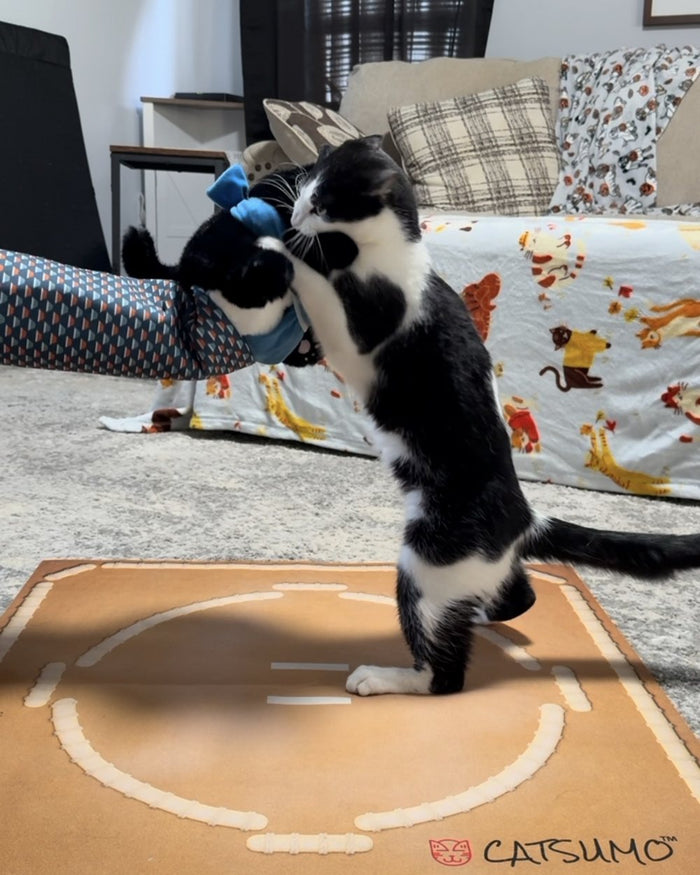
Once your cat grabs and holds, you can start wrestling properly: the push-and-pull, the side-to-side, the roll. This is what the padded head and long sleeve are for, so you can let them commit without paying for it in forearm.
Why: this is the play category your cat has been asking you for. Now they can have it safely.
Know what you're looking at
The four moves
Cats wrestle with a surprisingly fixed vocabulary. Learning to spot these four tells you exactly what your cat wants next, and each one has a specific thing you can do to feed it.

The Standoff
Low crouch, locked eyes, back end wiggling. Your cat has picked its target and is loading the pounce.
Feed it: hold completely still. Make them break first.
The Bear Hug
Both front legs wrapped around the puppet, pulling it into the chest. This is a cat committing.
Feed it: pull back gently. Give them something to hold on to.
The Boa Constrictor
Full-body wrap, all four limbs, rolling to the side or back. Peak wrestling. Also peak trust.
Feed it: go slack for a beat, then push back. Yo-yo, don't yank.
The Bunny Kicks
Grip with the front, machine-gun with the back. The finishing move, and the one that used to cost you skin.
Feed it: let them have it. This is what the padding is for.
Your side of the mat
Six techniques worth stealing
Every cat has a preferred style and finding it takes a bit of experimenting. Most cats like a mix of slow, deliberate movement and quick, spontaneous bursts. Try both and watch which one makes the ears go forward.
01The push and pull
Move the puppet like a yo-yo: in, out, in, out. Real tussles are back-and-forth, not one-directional. A toy that only retreats becomes a chase; a toy that only advances becomes a threat. The rhythm is the whole thing.
02Under the sheet
Wear the puppet under a bed sheet or blanket and move it slowly beneath the fabric. It hides your arm completely, muffles the human cues, and turns the whole surface into a hunting ground. This is the single best unlock for nervous cats. Many go from zero interest to full ambush in a single session.
03Play to the side, not the front
Cats that flop onto their side or back aren't surrendering. They're getting all four weapons into play. Encourage it by working the puppet along their flank rather than head-on. Head-on reads as confrontation; side-on reads as an invitation.
04Let them win, on purpose
Every 30 seconds or so, lose. Let the puppet get pinned, go limp, and "die". Then twitch it back to life. Cats disengage from targets that are impossible to catch far faster than from ones that fight and lose.
05Follow their lead
Letting your cat set the pace helps them feel in control, and cats that feel in control play longer. If they pause, pause with them. The temptation to keep the toy moving during a break is what ends a lot of sessions early.
06Play before food, not after
Hunt, catch, eat, groom, sleep. That is the sequence a cat's day is built around. Slot a session in just before a meal and you're working with the wiring instead of against it. It's also the most reliable way to buy yourself a quiet evening.
When it isn't working
What your cat is doing, and what to try tonight
| What you're seeing | What's going on | Try tonight |
|---|---|---|
| Leaves the room entirely | Threat rating too high, too fast. | Drop to rung one. Puppet on the floor, in their space, untouched, overnight. |
| Watches but won't come closer | Curious, not convinced. Very common on days 2–4. | Move it away from them, never toward. Or hide it under a blanket and let just the ears show. |
| One sniff, then nothing | Filed as furniture. No prey signal yet. | Add sound and jerk. Crinkle the ears, then short erratic twitches. Smooth motion reads as inanimate. |
| Plays for 20 seconds, quits | The toy is too easy or too impossible to catch. | Let them win one. Go limp on contact, then revive. Sessions get longer fast. |
| Was obsessed, now bored | Usually stale catnip, not a stale toy. | Swap the sachets. Catnip loses its punch once it's been opened, squashed and slept on. |
| Goes way too hard, immediately | Backlog. This drive has had nowhere to go until now. | Shorter, more frequent sessions. Ten minutes, two or three times a day, beats one long war. |
| Redirects onto your other hand | Your free hand entered the ring and became a target. | Keep the spare hand behind you. One opponent on the mat at a time. |
| Play flips into real aggression | Overstimulation. The tail and ears warned you first. | Stop dead and freeze. Puppet goes still, you go quiet. Resume in a few hours, not minutes. |
House rules
How much, how often, and when to stop
- Dusk and dawn are free wins. That's when the hunting drive peaks, which is also when your ankles usually pay for it.
- Always end on a catch. Finishing on a miss leaves your cat wound up. Finishing on a win closes the loop.
- Stop before they do. Ending one minute early keeps the puppet exciting. Ending five minutes late teaches them it's boring.
- Watch the tail, not the paws. A thrashing tail, flattened ears or a dilated stare means the session is over, whatever the paws are doing.
- Put it away between sessions. A toy that's always available stops being an event. Out of sight, back to full value.
If you want to go further
Two things that fix the two most common stalls
Neither is required. Both solve a specific problem people write to us about.

Catnip Refill Pack
For the cat that loved it for three weeks and then stopped. Fresh sachets drop into the puppet's pockets, and that is usually all it takes.
See the refill pack →
Dohyo Wrestling Mat
For the cat that plays everywhere except where you want them to. A fixed ring gives the session a start line, and gives their claws something that isn't your rug.
See the mat →In the wild
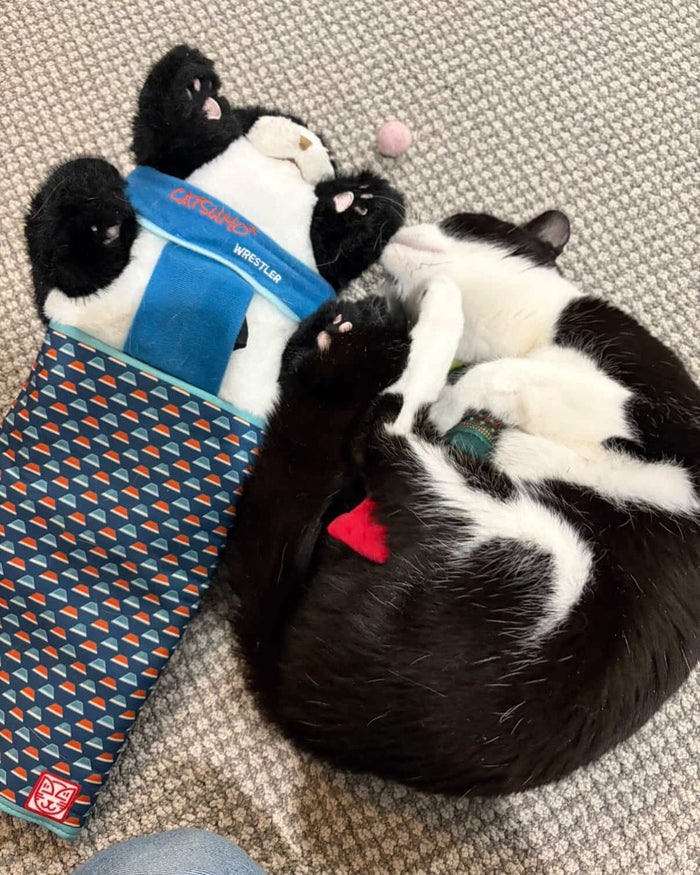
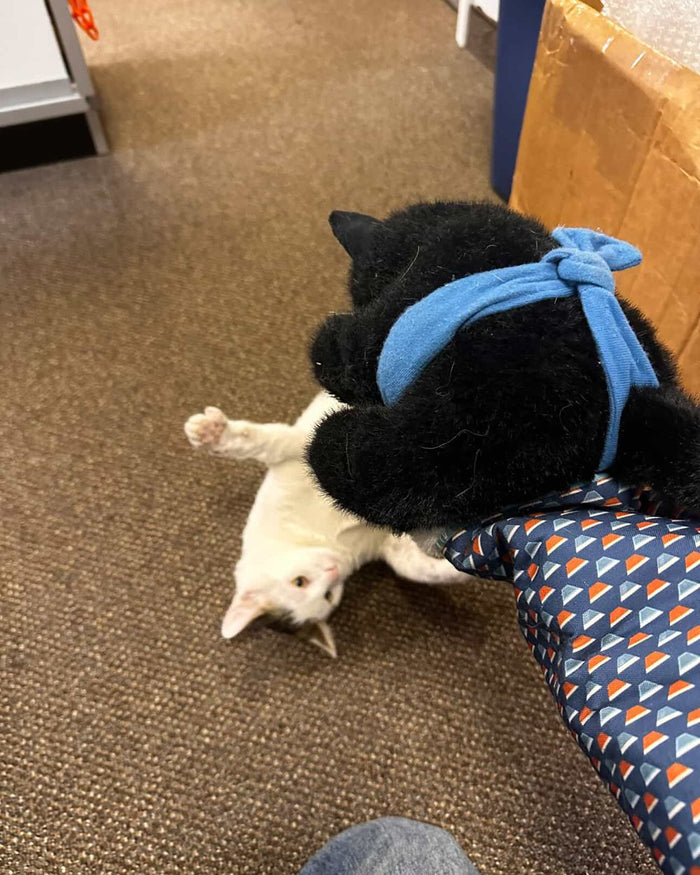
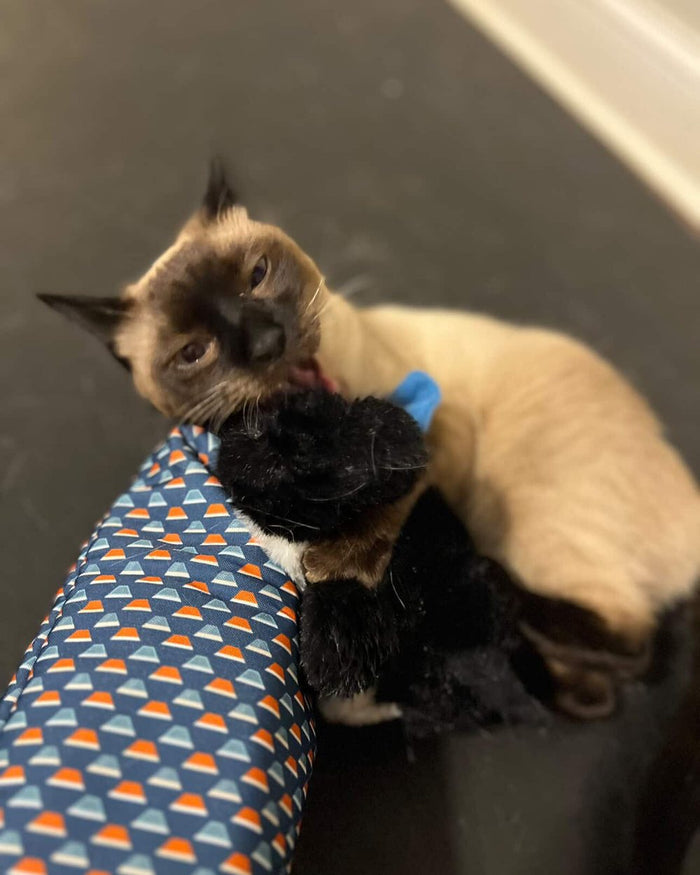
Cats who got there
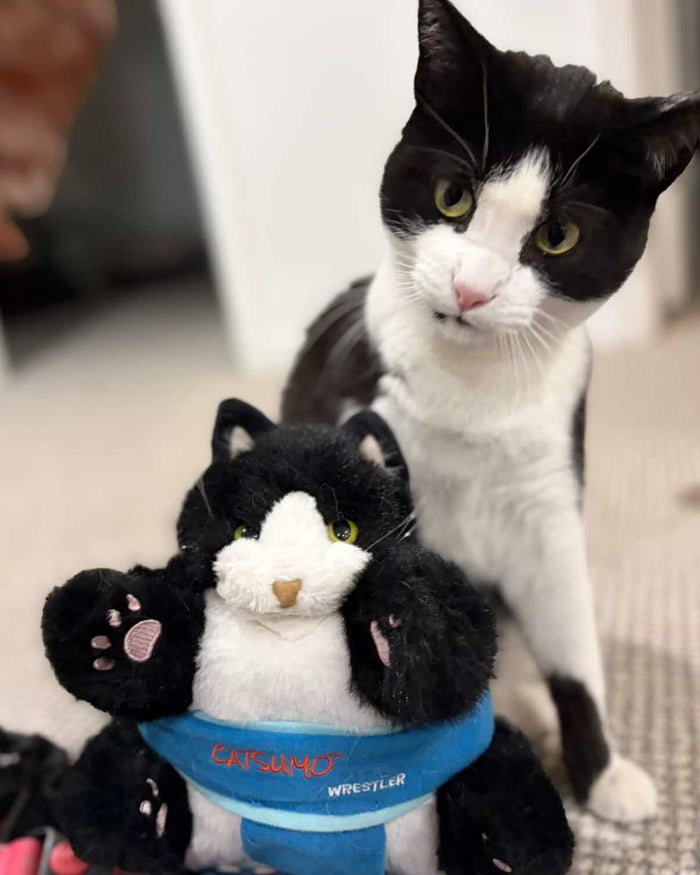
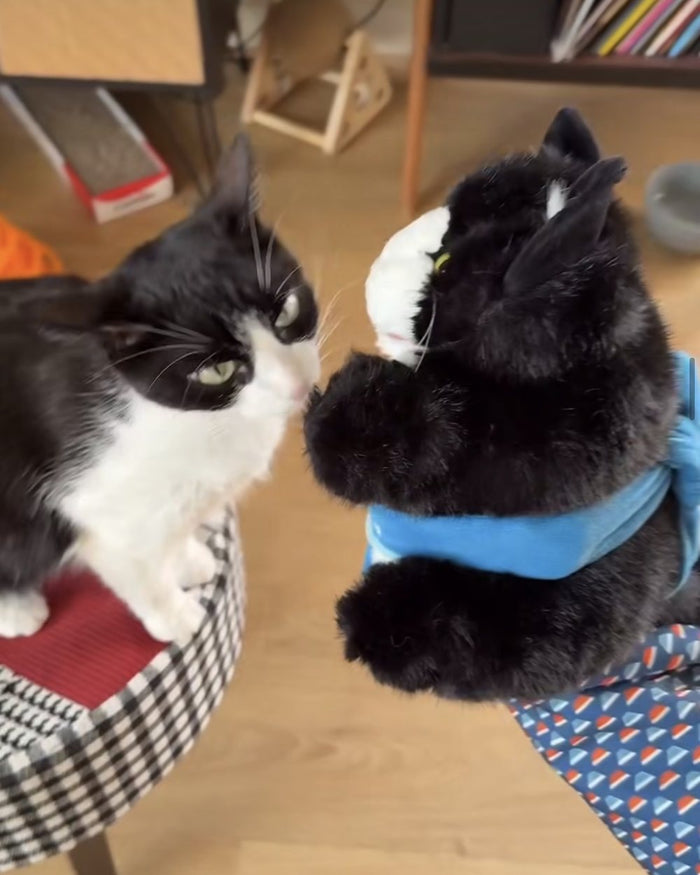
Every one of these started with a cat backing away from something new on the floor.
Before you go
Looking after the puppet, and your arm
The honest version
The Wrestler gives you substantial protection, but it is not impenetrable. It's built for a cat with normal bite inhibition, and no fabric on earth stops a determined set of canines forever.
Check it regularly. Look over the sleeve, seams and head for punctures or thinning after heavy sessions, and replace it once the padding is compromised. A damaged puppet stops protecting you and starts shedding material your cat can swallow.
If your cat plays extremely hard, start with sleeve-only access. Keep your fingers out of the head and let them work the empty end until you can read their intensity properly.
And if the aggression is sudden, escalating, or aimed at people unprovoked, that's not a play problem. Talk to your vet.
The original wearable cat wrestling puppet · Free shipping